Qatar Student Visa 2026: Requirements, Documents & How to Apply
International students who do not already hold a valid Qatar residence permit generally need a student visa before they can study in Qatar. GCC citizens are treated differently. The Ministry of Interior (MOI) approves the visa, but in practice your university usually runs the process: it applies for your entry visa and, after you arrive, converts it into a student residence permit under its sponsorship. Each institution sets its own checklist and deadlines, so always follow your university’s instructions.
What Is a Qatar Student Visa?
A Qatar student visa is the entry permission an international student needs to come to Qatar to study. Visit Qatar (Qatar Tourism) states that international students without a valid Qatar residence permit, excluding GCC citizens, must apply for one. Hukoomi lists it as the Educational Residence Visa, a service provided by MOI.
Admission and visa approval are two separate decisions in general. At Qatar University (QU) they run together: applicants who cannot meet the student visa requirements are not considered for admission, and the final admission decision comes after visa applications are verified. Approval is still subject to committee review.
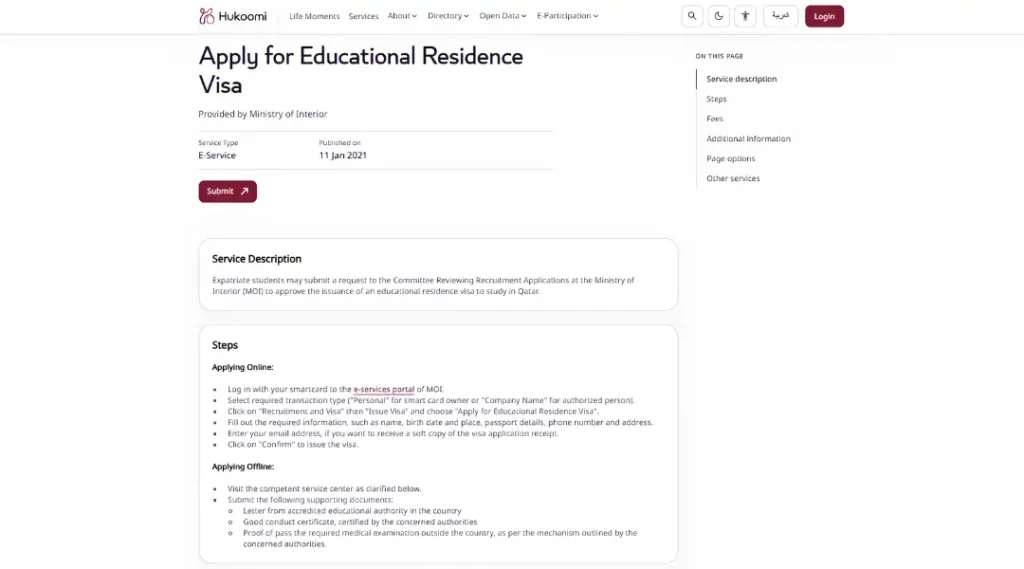
The Official MOI Route on Hukoomi
Hukoomi describes the Educational Residence Visa as a request that expatriate students submit to the Committee Reviewing Recruitment Applications at MOI.
- Online: log in with your smart card to the MOI e-services portal, open Recruitment and Visa, then Issue Visa, and choose Apply for Educational Residence Visa. Fill in your details and confirm.
- Offline: visit the competent service center with a letter from the accredited educational authority, a good conduct certificate certified by the concerned authorities, and proof that you passed the required medical examination outside Qatar.
- Fees: Hukoomi states the visa is issued for free.
Hukoomi’s page shows a 2021 publication date, so confirm the current steps on the portal. For students applying from abroad, the university normally submits the request on their behalf. See the Hukoomi Educational Residence Visa service.
Who Can Apply for a Qatar Student Visa?
- International students outside Qatar. This is the main group. QU, for example, accepts international applicants without a Qatar residence permit only if they apply as a self-funded student, an undergraduate scholarship applicant, or a graduate (Master’s or PhD) applicant.
- Students already living in Qatar. If you hold a valid residence permit, the visa step does not apply in the same way. QU lets current students transfer their residence permit from a parent or company sponsor to the university.
- GCC citizens. Visit Qatar and QU exclude them from the student visa requirement. At QU, GCC graduate applicants must obtain a Qatar ID card themselves, and their application is not considered until they do. GCC applicants should confirm their position with the institution.
- Undergraduate and graduate students. QU’s process covers undergraduate, Arabic for Non-Native Speakers (ANNS), Master’s and PhD applicants. For other institutions, ask the admissions office.
Qatar Student Visa Requirements 2026
No single checklist applies to every institution. This table separates what official pages state from what varies.
| Requirement | What it means | Source and notes |
| Admission or confirmation | A letter from the institution | Hukoomi lists a letter from the accredited educational authority. Visit Qatar lists a college confirmation letter. |
| Passport | Valid for a set period | Varies. Visit Qatar says valid for six months after studies finish. QU’s visa application page asks for a copy valid for at least one year. |
| Financial documents | Proof the studies and stay can be funded | Listed by Visit Qatar and QU. Format and amounts are university-specific. |
| Health documentation | Medical proof before travel | Hukoomi mentions a medical examination outside Qatar. Visit Qatar lists blood test, chest X-ray and HIV test. QU uses its own Health Evaluation form. |
| Good conduct certificate | Police clearance | Listed by Hukoomi (offline route) and QU. Confirm with other institutions. |
| Parent or guardian consent | Consent to enrol and obtain residence under the university’s sponsorship | QU only, and for undergraduate students only. |
Documents Required: Common Items vs University-Specific
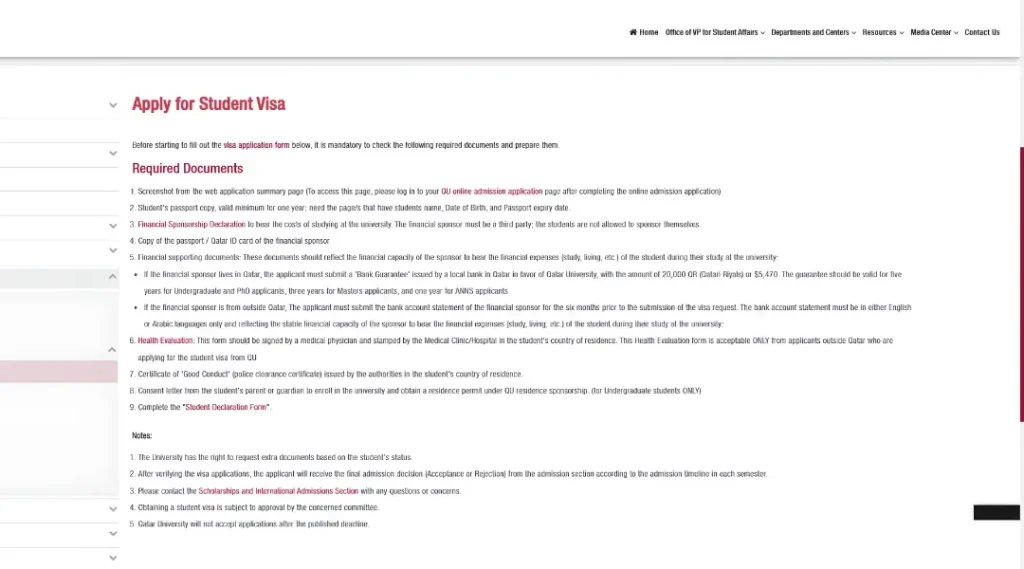
Commonly stated: admission or confirmation letter, passport, financial proof, health report and, in some cases, a good conduct certificate.
Qatar University only (may differ elsewhere):
- Screenshot of the web application summary page from your QU online admission application.
- Passport copy valid for at least one year, showing your name, date of birth and expiry date.
- Financial Sponsorship Declaration. The sponsor must be a third party, so you cannot sponsor yourself.
- Copy of the sponsor’s passport or Qatar ID card.
- If the sponsor lives in Qatar: a bank guarantee from a local bank in QU’s favour of QR 20,000 (QU lists this as about $5,470). It must be valid for five years for undergraduate and PhD applicants, three years for Master’s applicants and one year for ANNS applicants.
- If the sponsor lives abroad: bank statements for the six months before the visa request, in English or Arabic only.
- Health Evaluation form, signed by a physician and stamped by the clinic or hospital in your country of residence. QU accepts it only from applicants outside Qatar.
- Good conduct (police clearance) certificate from your country of residence.
- Parent or guardian consent letter (undergraduate students only).
- Student Declaration Form.
- Any extra documents QU requests.
This is QU’s list, not a national checklist. QU also says IELTS is optional for the visa application, though it may support your file.
How to Apply for a Qatar Student Visa
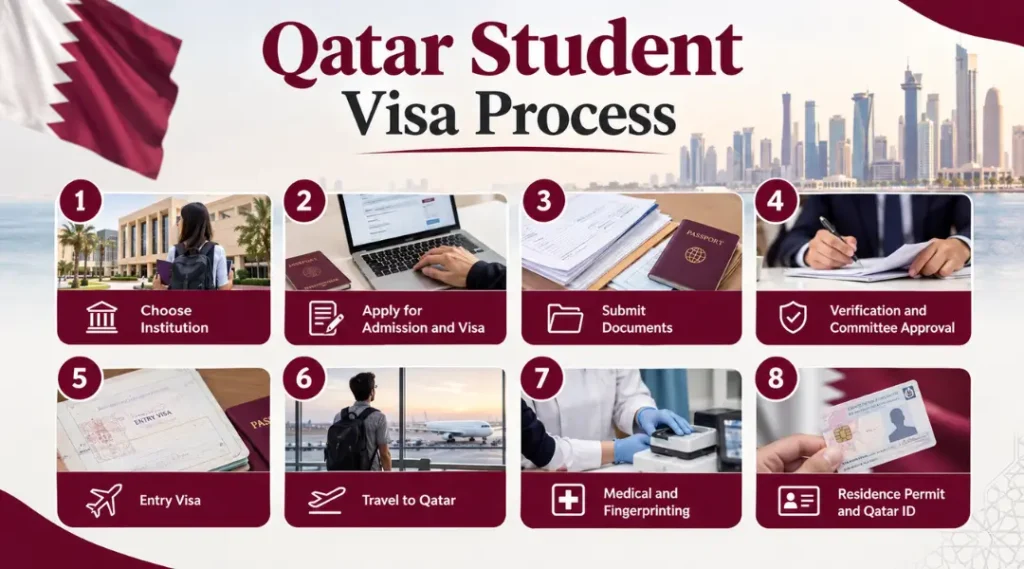
The steps below follow what official university sources describe. The portal and order differ by institution.
- Choose an institution and check its international student page.
- Apply for admission. At QU, international applicants submit the visa application online within the same admission period.
- Prepare the required documents.
- Submit the visa application through the university’s channel. At QU this is the Scholarships and International Admissions Section.
- Upload everything before the deadline. QU does not accept late applications.
- Wait for verification and committee approval. Approval is not guaranteed.
- Receive the entry visa from your university before you travel.
- Travel to Qatar only after you hold the entry visa.
- Complete post-arrival procedures: medical examination and fingerprinting.
- Receive the residence permit and Qatar ID card.
Undergraduate scholarship applicants at QU do not fill out the visa application. The Scholarships and International Admissions Section arranges the visa for those awarded a QU scholarship.
Qatar Student Visa Processing Time
Hukoomi does not publish a processing time for the Educational Residence Visa, and no universal timeline was found in the sources reviewed. Admission decisions, document checks and visa approval are separate steps, so your overall timeline can be longer. Ask your university.
Qatar Student Visa Fees
Hukoomi states that the Educational Residence Visa is issued for free. That does not mean studying in Qatar costs nothing. Keep these costs separate:
- Visa-related charges. Some institutions pass these on. University Foundation College (UFC), for example, says students cover visa processing fees.
- University application and tuition fees. At QU the online admission application fee is not refunded if you are not accepted.
- Medical examination costs.
- Residence permit costs. UFC lists residence permit and medical fees as payable after the visa is obtained.
What Happens After You Arrive in Qatar?
QU says all students need a residence permit to live and study in Qatar. It describes converting the entry visa into a residence permit under QU sponsorship within one month of entry, through three steps:
- Medical examination at the Medical Commission.
- Fingerprinting at the Criminal Evidence and Information Department.
- A blood type test certificate.
At QU, a student who fails the medical examination must leave Qatar within 48 hours, and students may not travel outside Qatar until the residence permit card is issued. Other institutions give their own estimates for the permit: Northwestern University in Qatar says the full process takes 3 to 6 weeks, and Georgetown University in Qatar says 4 to 6 weeks. Once issued, you receive a Qatar ID card. To verify its details later, see our Qatar ID check guide.
Student Visa vs Qatar Residence Permit
| Details | Student Visa | Qatar Residence Permit |
| Purpose | Permission to enter Qatar to study | Legal status to live in Qatar |
| When used | Before and at arrival | After arrival, for the rest of your studies |
| Process | Approved by MOI and arranged by the university before travel | Medical examination and fingerprinting after arrival |
| Relationship | The first stage | Issued under the university’s sponsorship; the Qatar ID card is the physical proof |
Can a Student Bring Family Members?
No Qatar-wide student rule was found. QU states that its student visa is valid for the student only and gives no right to sponsor family members under student sponsorship. Other institutions may differ. If a family member qualifies under a different sponsor, see our Qatar family residence visa guide.
Scholarship vs Self-Funded Students
At QU, the visa route depends on how you are funded. This is QU policy, not a national rule.
| Student type | Visa consideration (QU) |
| Undergraduate or ANNS, self-funded | Apply for the visa and upload documents in the admission period |
| Undergraduate, scholarship | No visa application needed; the university arranges the visa for those awarded a scholarship |
| Master’s or PhD | Apply for the visa; QU states there are currently no scholarships for graduate applicants |
| Graduate with an assistantship | Still submit the visa application and the financial supporting documents |
For other universities, no verified official breakdown was found. Check with the admissions office.
Can You Work on a Qatar Student Visa?
No national rule on student work or working hours is published on the pages reviewed, so this article does not state one. What is documented is institutional. UDST’s International Student Policy says international students may apply to its Student Employment Program under its own regulations. QU runs a Student Employment Program for enrolled students who meet its conditions, such as at least 24 completed credit hours and a GPA of 2.5 or above, with the GPA condition waived for ANNS and graduate students. These are university programs, not national immigration permissions. A student residence permit should not be treated as general permission to work. Ask your international office before accepting any job or internship.
What Happens After Graduation?
QU says graduates must settle their residence permit by cancelling it or transferring it to another sponsor. Transfer is possible only after graduation.
- Cancel and leave: you can stay up to five days after receiving your graduation statement.
- Transfer: to a father, brother, husband (personal sponsor) or a company. Documents are due within one month after final exams, and the transfer must be completed within two months.
- ANNS students cannot transfer and must cancel.
No official post-study work visa was found. Employment after graduation depends on a new sponsor. See our Qatar work visa guide.
Common Mistakes
- Treating admission as visa approval.
- Using another university’s checklist.
- Missing the visa deadline (QU rejects late applications).
- Assuming scholarship and self-funded students follow the same steps.
- Submitting a parental consent letter or other documents that do not apply to your level of study, or leaving out ones that do.
- Traveling before the entry visa is issued.
- Leaving Qatar before the residence permit card is issued (QU prohibits this).
- Confusing the visa with the residence permit and the Qatar ID.
- Treating a private service’s turnaround as an official processing time.
What If Your Visa Is Delayed or Refused?
Contact your university’s international admissions or visa office first. QU lists internationalstudents@qu.edu.qa for visa questions. Confirm whether extra documents are needed, since QU reserves the right to request them. No official appeal process is documented in the sources reviewed, so do not assume one exists. If your case involves a visa or residence status, you can check your Qatar visa status through the official channels.
Frequently Asked Questions
What is a Qatar student visa?
The entry permission an international student needs to study in Qatar. Hukoomi lists it as the Educational Residence Visa. It is usually arranged through the university and later converted into a residence permit.
Who needs one?
International students without a valid Qatar residence permit, excluding GCC citizens, according to Visit Qatar and QU.
What are the requirements?
They vary by institution. Common items are an admission or confirmation letter, passport, financial proof, a health report and sometimes a good conduct certificate.
How do I apply?
Through your university’s process, which submits the request to MOI’s committee. See the steps above.
How much does it cost?
Hukoomi states the visa is issued for free. Tuition, application, medical and residence permit costs are separate, and some institutions pass on processing charges.
How long does it take?
No official processing time is published. The 72 hour figure on Visit Qatar’s page refers to a private service, not an official timeline.
Can I apply without admission?
At QU, the visa application is part of the admission process, and applicants who fail the visa requirements are not considered for admission. Other institutions vary.
Can I study without a residence permit?
QU says all students need a residence permit to live and study in Qatar.
Can I bring my family?
QU says no under student sponsorship. No Qatar-wide rule was found.
Can I work?
No verified national rule. Check your university’s student employment program.
What happens after I arrive?
Medical examination, fingerprinting and a blood type certificate, then the residence permit and Qatar ID card.
Does the visa become a residence permit?
Yes. QU describes converting the entry visa into a residence permit within one month of entry.
What happens after graduation?
Cancel or transfer the residence permit, following your university’s rules. At QU, transfer is possible only after graduation.
Is a student visa different from a residence permit?
Yes. The visa is for entry. The permit is for residing.
Note: MOI, Hukoomi and university portals update their menus, requirements and deadlines from time to time. If a screen or checklist looks different from what is described here, follow the official portal or your university’s latest instructions. This guide is independent and is not affiliated with the Ministry of Interior or any university.