Bahrain Student Visa 2026: Requirements, Fees & How to Apply
Yes, Bahrain has a student visa. The Nationality, Passports and Residence Affairs (NPRA) issues a Student Visa to students admitted to a university or institute in Bahrain. Once the student arrives, NPRA issues a separate Student Residence Permit. The university normally files both applications. NPRA’s published government fees add up to BHD 105 for a first-time applicant (BHD 40 for the visa plus BHD 65 for the residence permit; the total is our own addition).
| Stage | Applied for | NPRA processing time | NPRA fees |
| Student Visa | From outside Bahrain | 3 working days | BHD 5 + 5 + 30 = BHD 40 |
| Student Residence Permit | From inside Bahrain | 1 working day | BHD 5 + 60 = BHD 65 |
What Is a Bahrain Student Visa?
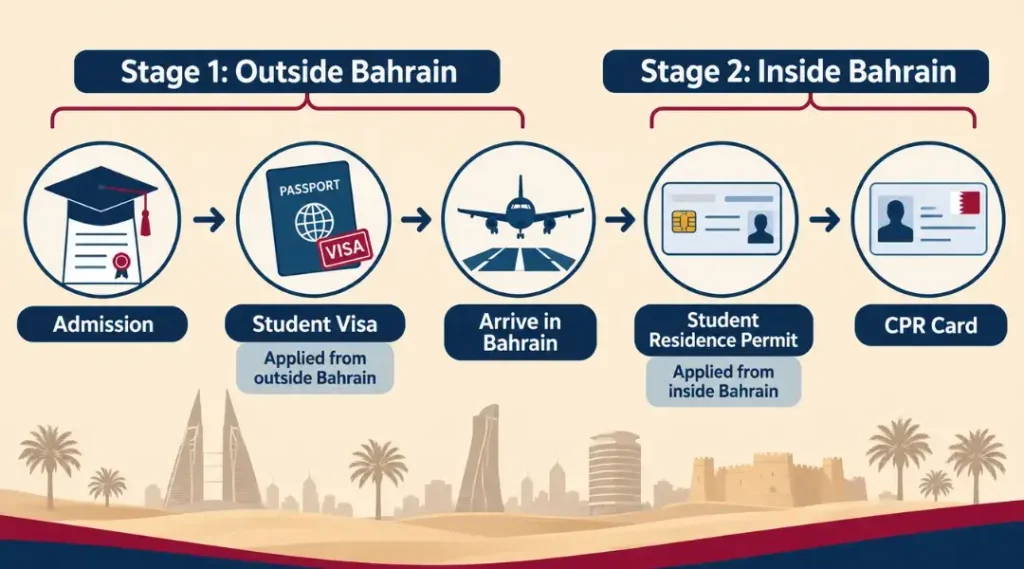
NPRA lists the Student Visa and the Student Residence Permit as two separate services:
- Student Visa: issued to students enrolled in local or international universities or institutes in Bahrain. You apply while you are outside the country.
- Student Residence Permit: the residence stage. You apply while you are inside Bahrain. NPRA notes that students studying at an institution in Bahrain are required to have residence in the country.
NPRA’s visa services list shows no other study-specific visa category. Searches for a “Bahrain study visa” lead to this same route.
Residents on a student residence permit may not work, paid or unpaid. Employment follows a different route; see our Bahrain work visa guide.
Who Can Apply?
- Students enrolled at a local or international university or institute in Bahrain, as NPRA words it.
- The application must be filed by a guarantor or an authorized person. In practice, universities such as RCSI Bahrain and Applied Science University handle the submission for their international students.
- Each application is filed separately with its own documents.
NPRA’s student pages do not list nationality restrictions. See the nationality section below.
Bahrain Student Visa Requirements
Student Visa (from outside Bahrain)
Per NPRA:
- Application form (submitted at a service centre only)
- A clear copy of your passport that has been valid for more than six months
- A clear copy of the ID card of the applicant or their legal representation
- Official letter from the university or institute where you are enrolled
Student Residence Permit (from inside Bahrain)
Per NPRA:
- Application form (service centre only)
- Clear copy of the ID card of the applicant or the authorized person filing
- Clear copy of the student’s enrolment letter
NPRA can ask for additional documents at any time. The older national portal listing for the same service also mentions the student’s original passport, so keep it ready in case your university or NPRA asks for it.
University Checklists
Universities add their own requirements. These are university rules, not NPRA rules:
- Applied Science University: passport copy, birth certificate, student certificate from Admission and Registration, a financial statement from the university, proof of a Bahrain address (municipal certificate or electricity bill in the student’s name) and a signed commitment form. Students with GCC residents also provide their residence permit, their parents’ passports and residence permits, and the parents’ marriage contract or family book. ASU’s page also states that the student is responsible for all government fees. That line appears under the GCC-resident list, so ask ASU whether it applies to you.
- University of Technology Bahrain: a letter from a parent or guardian requesting student sponsorship, a copy of the parent’s or guardian’s employment certificate showing salary, and copies of the passport, national ID and residence permit for both student and parent or guardian. UTB’s international student page also lists registration for the maximum number of courses each trimester and payment of tuition for one year (three trimesters). Per the university, the student bears the visa processing fees.
- RCSI Bahrain: a passport copy, details of your current country of residence and any other residence permits, and proof of the visa fee payment.
Ask your admissions office for its current checklist before you pay anything.
Application Process
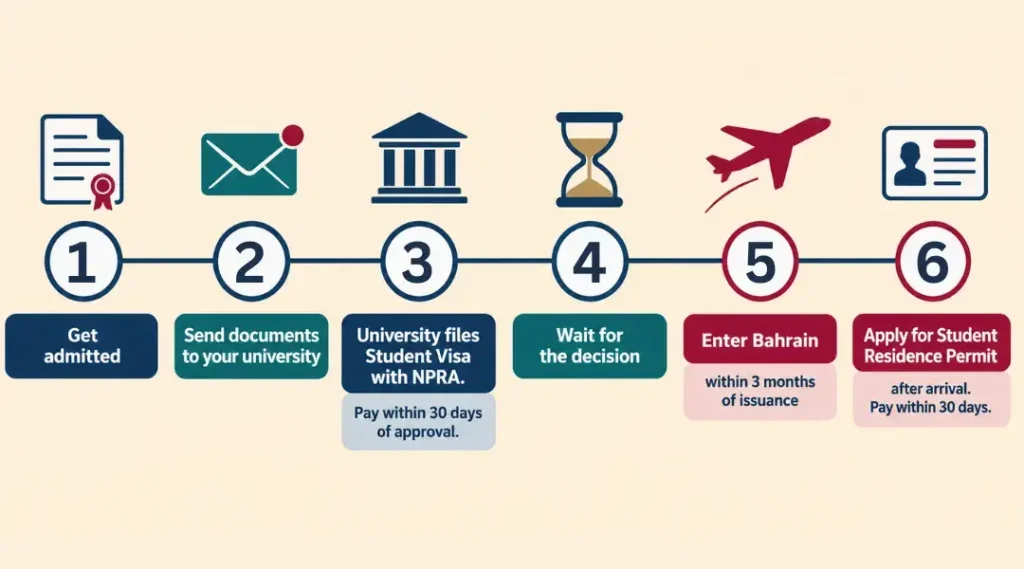
- Get admitted and confirm that your university will file the visa application.
- Send the university your documents and pay any visa charge it collects.
- The university files the Student Visa application with NPRA while you are abroad. NPRA’s application form is for submission at a service centre only. Payment must be made within 30 days of approval, or the application is cancelled automatically.
- Wait for the decision. See the processing times below, and start early.
- Enter Bahrain within three months of issuance. An unused visa becomes invalid. RCSI Bahrain adds that its approved visa works as a temporary NOC that allows a single entry, and that it needs your travel dates so your documents reach airport immigration. Without them you may be held up at the airport.
- Once you are there, apply for a student residence permit. NPRA publishes 1 working day, with the same 30-day payment window. At RCSI Bahrain, for example, students then provide a proof-of-address letter from the municipality and book a Smart Card (CPR) appointment. The passport is returned with a multiple re-entry visa.
Processing Time
NPRA publishes 3 working days for the Student Visa and 1 working day for the Student Residence Permit. Universities report longer waits for the visa. RCSI Bahrain says it can take up to two months or longer, depending on the applicant’s nationality and other factors, and advises submitting at least two months before arrival. Applied Science University’s visa FAQ gives the same warning.
If Your Visa Is Not Ready by the Start of Term
RCSI Bahrain says late students must enter on a visit visa sponsored by the university. It says a self-applied or on-arrival visit visa cannot later be converted to a student visa, and the student visa fee in that case is USD 1,176, plus visit visa charges. Other universities may have different rules, so ask yours before you book a flight.
Bahrain Student Visa Fees
| Fee line (NPRA) | Student Visa | Student Residence Permit |
| Application fee (non-refundable) | BHD 5 | BHD 5 |
| Visa approval fee | BHD 5 | n/a |
| Issuance fee | BHD 30 | BHD 60 |
| Total | BHD 40 | BHD 65 |
NPRA lists the residence permit renewal fee as BHD 60, shown alongside the BHD 5 application fee, so a renewal comes to BHD 65.
The older eService on the national portal lists BHD 64 for both issuing and renewing a student residence. NPRA’s own pages itemize BHD 5 + BHD 60. Pay the amount shown on the official payment screen.
University Charges
University charges are separate from NPRA’s fees. RCSI Bahrain, for example, charges a non-refundable USD 514 standard student visa fee, which it says includes the Smart Card, and notes that an extra USD 29 multiple-entry visa cancellation fee may apply in some cases. At University of Technology Bahrain, visa processing fees are borne by the student. Your total depends on your institution.
Bahrain Study Visa Price in Pakistan
NPRA publishes its fees in Bahraini dinars only, and its student pages show no nationality-based fee differences. A Pakistani applicant therefore pays the BHD amounts above, converted at the exchange rate on the day of payment, plus any university or agent charges. No official Pakistani rupee price exists. Check the live BHD to PKR rate before you budget.
Medical Screening and Attested Documents
NPRA’s student pages list no medical test, but some universities require one:
- RCSI Bahrain says all international students are tested for blood-borne viruses on arrival, as mandated by the Ministry of Health. It arranges the tests during Orientation Week and says a positive result means the student is not eligible to study there and will be repatriated.
- University of Technology Bahrain lists a student medical examination, issued by a medical centre endorsed by Bahrain’s Higher Education Council, among its undergraduate admission documents. That is an admission requirement, not an NPRA visa requirement.
Ask your university whether a medical test applies to you, and what happens after the result, before you travel.
We found no official Bahrain page that lists attestation or police clearance for the student visa. Universities do ask for certified documents at admission:
- UTB’s admission leaflet lists a Certificate of Good Moral Character. It does not say who must issue it. The leaflet also says Higher Education Council rules on authenticating foreign certificates apply when necessary.
- The University of Bahrain’s visiting student service asks for authenticated transcripts.
These are admissions rules rather than visa rules, so ask your university which documents need attestation and who must issue each one.
Validity and Renewal
- Student Visa: valid for entry only if used within three months of issuance.
- Student Residence Permit: NPRA says it can be issued or renewed for 5 years for students at local universities or institutes, and for one year for students enrolled at institutions abroad. NPRA’s Student Visa page defines the same split as students “registered locally” (5 years) versus “registered internationally” (one year). NPRA does not spell out exactly who counts as registered internationally, so confirm with your university which period applies to you.
- Renewal: filed inside Bahrain, with a published processing time of 1 working day. NPRA’s page lists the same documents as a new application. The older national portal listing adds an official letter from the university or institute and the student’s original passport. Ask your university whether it issues the letter and files the renewal for you.
Your CPR card follows your residence permit. Our Bahrain visa renewal guide explains the order.
Student Visa for Pakistani, Indian and Bangladeshi Applicants
NPRA publishes one set of documents, fees and timelines for the student route. It lists no different requirements for Pakistani, Indian or Bangladeshi passport holders, so the process above applies to all three.
Where nationality can matter in practice, according to universities rather than NPRA:
- Processing time: RCSI Bahrain and Applied Science University both say visa processing can take up to two months or longer depending on nationality. ASU’s statement comes from a university FAQ dated May 2023, so ask ASU whether it still applies.
- Visit visa charges: RCSI Bahrain says visit visa and extension costs for late arrivals depend on nationality.
We found no official page that adds nationality-specific documents. If your university asks for extra paperwork, ask whether the request comes from NPRA or from the university.
Frequently Asked Questions
Will I get my money back if the visa is rejected?
NPRA’s application fee is non-refundable. RCSI Bahrain says visa approval is at the discretion of Bahrain’s immigration authority, that it cannot guarantee approval, and that visa fees paid to it are not refunded after a rejection. No university can promise approval.
Does a student residence permit lead to permanent residence?
NPRA’s student pages describe no path from the student permit to permanent residence or another residence category. We could not confirm one.
NOTE: GulfVisaGuide is an independent information site, not a government website. Rules and fees can change, so confirm with NPRA and your university before paying.