
Most people searching for a Kuwait work visa already have one specific question buried underneath the broader term: which category applies to their situation, and what does their employer actually need to do to sponsor them. Kuwait runs three distinct employment-based residency categories, Article 18, Article 17, and Article 20, each with a different sponsor, a different governing process, and different rules about switching employers later.
This guide focuses on that decision layer: how the three categories differ, what your employer is legally obligated to do before you can even apply, and where to go for the deep-dive fee and step-by-step breakdown once you know which category fits you. For the full Article 18 fee schedule, the detailed application timeline, and the exit-permit and transfer rules in complete depth, our dedicated Article 18 Kuwait visa guide covers that ground thoroughly. This article is the map that gets you there.
How Kuwait’s Work Visa System Actually Works
Two government bodies run the entire process, and understanding the split saves a lot of confusion later:
- PAM (Public Authority for Manpower): approves the work permit itself, based on your employer’s commercial licence, sector quota, and your job match. This runs through PAM’s online Ashal system.
- Ministry of Interior (MOI): issues the entry visa and, after you arrive, converts your status into a residence permit (Iqama) through its Residency Affairs Department.
- PACI (Public Authority for Civil Information): issues your Civil ID once your Iqama is approved, which becomes your primary ID for banking, phone contracts, and daily transactions.
Every visa category is defined by an “Article” number under Kuwait’s Aliens’ Residence Law, and that number is printed directly on your Civil ID. It determines whether you can work, who your legal sponsor is, and how you can (or can’t) change employers.
Article 18 vs. Article 17 vs. Article 20: Which One Applies to You?
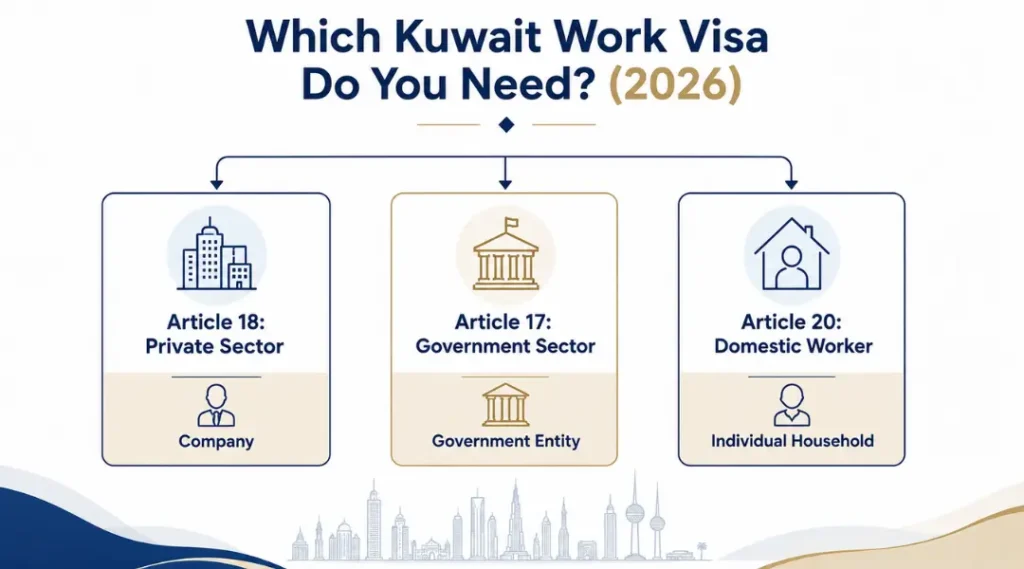
Article 18: Private Sector Work Visa This is the one most people mean when they search for a Kuwait work visa: it covers employees hired by PAM-registered private companies, and it’s tied to that employer for the duration of the contract. It’s also the category with the most moving parts (exit permits, transfer or “Tanazul” rules, and a fee schedule with several components), which is exactly why we’ve kept that detail in its own dedicated page rather than duplicating it here.
Article 17: Government Sector Work Visa For expatriates employed directly by Kuwaiti government bodies or public-sector institutions. The sponsoring government entity handles the process together with the MOI, and the overall flow mirrors Article 18 closely, just with a government sponsor instead of a company. Kuwait does allow transfers between the two, moving from a government role (Article 17) to a private-sector one (Article 18), provided the profession stays the same or closely related, and only after the sponsor formally releases the transfer through PAM.
Article 20: Domestic Worker Visa Used for household staff sponsored by an individual rather than a company, run through PAM’s Ashal platform with its own separate quota, recruitment-agency rules, and salary floor. Domestic worker sponsorship is genuinely a different process from standard employment, with different documents, different salary rules, and different employer obligations, so it deserves its own dedicated guide rather than being folded into this comparison.
Kuwait Work Visa Comparison Table (2026)
GCC nationals (Bahrain, Oman, Qatar, Saudi Arabia, UAE) generally get simplified entry through residency cards and skip most of the quota requirements that apply to other nationalities.
Employer Obligations Before You Can Even Apply
This is the part most “how to apply” guides skip, but it’s often the actual bottleneck: your visa can’t move forward until your employer clears its own requirements with PAM.
- Valid commercial licence and PAM registration: Only companies registered with PAM and holding an active commercial licence can sponsor a foreign worker at all. An informal job offer from an unregistered entity cannot be converted into a real work permit.
- Kuwaitisation quota compliance: Each sector has a required ratio of Kuwaiti nationals on payroll before new expatriate permits are approved. Banking, for instance, operates under a long-standing 70% Kuwaitisation requirement (Cabinet Resolution No. 1868 of 2018), and Kuwaitisation enforcement has continued tightening across several sectors in recent years, which can slow down how quickly a private employer gets a new hire’s permit through PAM.
- Wage Protection System (WPS) compliance: Employers must pay wages through authorised electronic bank transfers, which PAM monitors directly and cross-checks against registered employment contracts. Employers with a poor payment-compliance record can face restrictions on new permit approvals, including blocks on work permit renewals.
- Health insurance provision: Employers are required to provide health insurance coverage matched to the visa’s duration as part of the residency application, not as an optional benefit.
If you’re evaluating a job offer, it’s worth asking your prospective employer directly whether they’re within their Kuwaitisation quota for your role. A company at its quota limit may simply be unable to sponsor a new expatriate permit in your sector regardless of how strong your application is.
Already in Kuwait on a Visit Visa? Converting to a Work Visa
A growing number of applicants aren’t applying from abroad at all. They’re already in Kuwait on a visit visa and have just received a job offer.
You cannot simply start working on a visit visa; your employer still needs to file a fresh Article 18 work permit through PAM as if you were applying from outside the country, and in many cases you’ll need to exit and re-enter Kuwait once the permit and entry visa are approved, rather than converting status while still inside the country.If your visit visa is nearing its own expiry while this is being sorted out, check our guide on extending a Kuwait visit visa so you don’t fall out of status during the transition.
Fees, Documents, and the Application Process: Where to Find the Full Detail
Once you know which category applies to you, the practical mechanics (the exact fee schedule including the Article 18 work permit fee, Civil ID charges, and transfer fees; the required-documents checklist; medical and police-clearance steps; the mandatory exit-permit rule that now applies to every Article 18 worker leaving Kuwait; and the complete step-by-step timeline) are covered in full in our Article 18 Kuwait visa guide. We’ve kept that detail there rather than repeating it here so you’re only reading it once, in the place built to go deep on it.
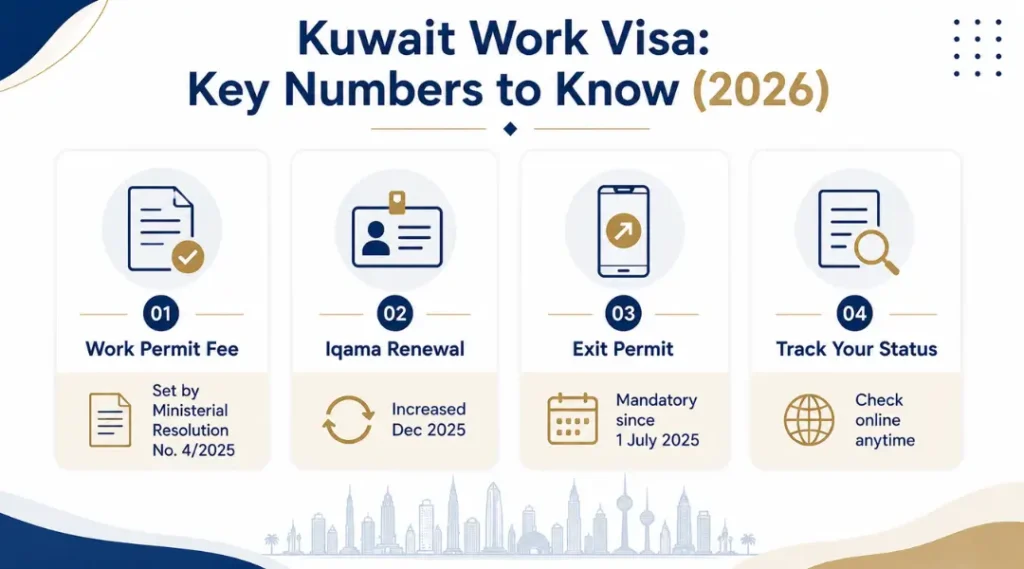
A few figures worth knowing at a glance while you’re still deciding:
- The core Article 18 work permit fee is a fixed government charge under Ministerial Resolution No. 4 of 2025, though government-owned companies, licensed healthcare providers, universities, private schools, and certain agricultural/industrial establishments are exempt from parts of it.
- Annual Iqama renewal increased as of 23 December 2025, now bundled with mandatory health insurance.
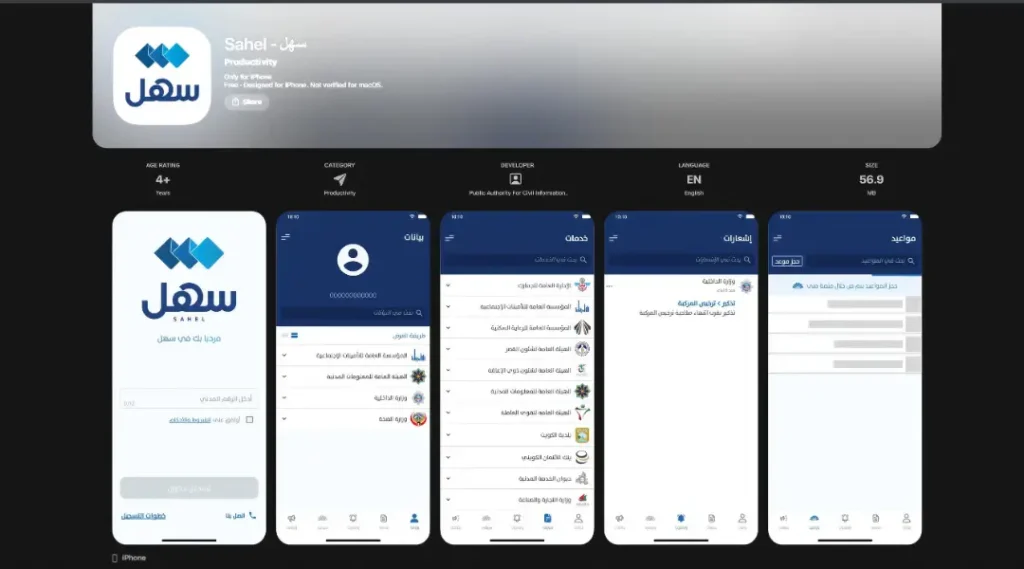
- Since 1 July 2025, every Article 18 private-sector worker, not just select categories, must obtain an employer-approved exit permit via the Sahel app before leaving Kuwait for any reason, valid for 7 days once issued.
- Once your application is submitted, you can track it yourself through our Kuwait visa check portal guide rather than relying on your sponsor’s word.
Separately, and this is often confused with a 2026 change, Kuwait relaxed its renewal rules for expatriates aged 60 and above without a university degree back in November 2024, removing an additional KWD 250 annual fee and a mandatory health-insurance requirement that had applied to that group since 2023. It’s an important standing rule to know if you fall into that age bracket, but it isn’t a new 2026 policy.
Frequently Asked Questions
Which Kuwait work visa category is right for me?
If you have a job offer from a private company, you need Article 18. A government or public-sector job offer needs Article 17. If you’re being sponsored by an individual family for household work, that’s Article 20 and follows a separate process entirely.
Can I apply for a Kuwait work visa without an employer sponsor?
No. Kuwait’s kafala system requires every standard work visa to be tied to a PAM-registered employer or, for Article 17, a government sponsor. There is no independent or freelance route into a standard employment residency.
What’s the difference between a Kuwait work visa and an Iqama?
The work visa is your entry authorization, tied to your work permit approval. Once you arrive and complete your medical test and biometrics, it converts into the Iqama, your actual residence permit for living and working in Kuwait long-term.
Can I switch employers on a Kuwait work visa?
Only with your current sponsor’s formal release (Tanazul) processed through PAM. Working for a new employer before that transfer is approved is treated as working without a valid permit and can lead to penalties.
Does Kuwait charge personal income tax on work visa salaries?
No. Kuwait does not levy personal income tax on salaries, which remains one of the most cited reasons expatriates choose to work there despite the strict sponsorship rules.
NOTE: This guide reflects Kuwait work visa rules as reported through PAM, the Ministry of Interior, and verified immigration-law updates as of 2026. Fees, quotas, and processing times are revised periodically. Always confirm current details directly with the Public Authority for Manpower or the Ministry of Interior before applying or paying any fee. For a full overview of every Kuwait visa category, see our Kuwait Visa Guide 2026.
3 thoughts on “Kuwait Work Visa 2026: Which Category Do You Actually Need?”