Kuwait Visit Visa 2026: New KD150 Residency Rules

If you’ve searched for Kuwait visit visa rules recently, you’ve likely come across excited posts claiming visit visa holders can now switch to residency freely. That’s only partly true, and getting the details wrong has already cost hundreds of applicants rejected paperwork and wasted trips to Residency Affairs departments. In August 2026, Kuwait’s Ministry of Interior introduced a new KD150 fee and a formal pathway for converting a visit visa into a regular residency permit, but it applies to a narrow, clearly defined set of categories, not every visitor in the country. This guide breaks down exactly what changed, who genuinely qualifies, and how to avoid the mistake that’s currently getting so many applications turned away.
What Actually Changed: The KD150 Conversion Fee
On 2 August 2026, Kuwait published Ministry of Interior Decision No. 1091 of 2026 in the official gazette, Kuwait Al-Youm, amending the executive regulations of the Foreigners Residence Law (Ministerial Decision No. 2249 of 2025). The change adds a new clause to Article 39 of those regulations, formally introducing a KD150 fee (roughly USD 485) for converting a Kuwait visit visa into a regular residency permit under Article 16, and it took effect immediately upon publication, according to reporting confirmed directly by Kuwait Times, the country’s oldest English-language daily.
This isn’t a blanket rule open to every visit visa holder. The Interior Ministry specified that only expatriates falling into defined categories can use this pathway at all, the KD150 fee is what you pay if you already qualify, not a fee that unlocks eligibility on its own.
Who Actually Qualifies for Visit-to-Residency Conversion
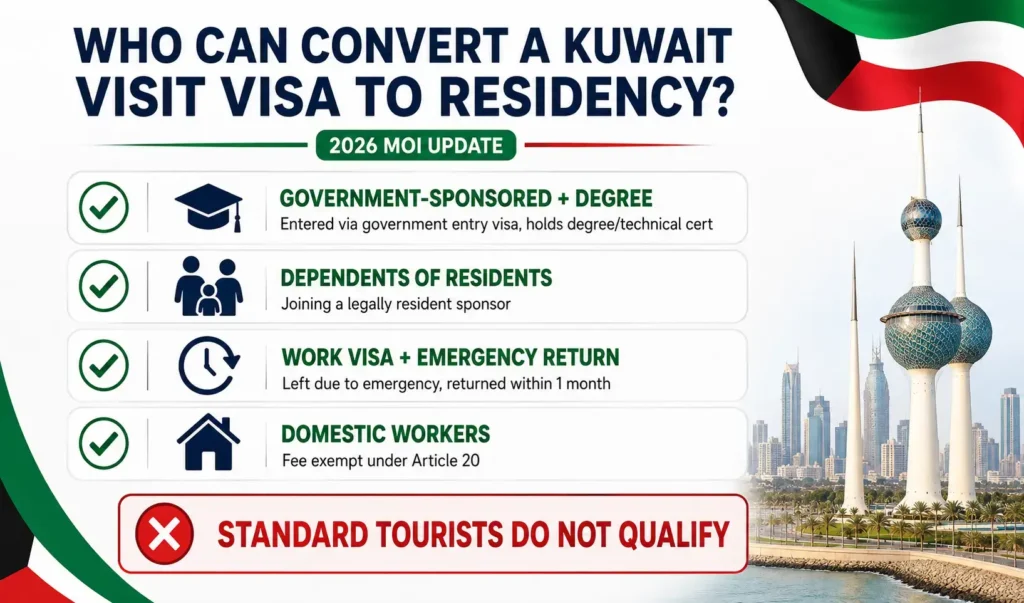
Based on the Ministry of Interior’s own categorisation, as reported by Gulf News, eligibility is limited to:
- Government-sponsored entrants with specialised qualifications. Foreign nationals who entered Kuwait on entry visas issued by a ministry, public institution, or government authority, but only if they hold a university degree or a recognised technical qualification.
- Dependents of legal residents. Family members who entered on a dependent or family visit visa and are joining an already-resident sponsor.
- Work-visa holders interrupted by an emergency. Foreign workers who had already started their residency process on a work visa, had to leave Kuwait due to an emergency, and returned within one month.
- Domestic workers and similar categories, who can convert their status but are exempt from paying the KD150 fee entirely, under Article 20 of the executive regulations.
What isn’t covered is just as important as what is. A standard tourist entering on an ordinary Kuwait visit visa for leisure, with no government sponsorship, no dependent relationship to a resident, and no prior work-visa history, does not qualify under this route. Times Kuwait reported that hundreds of applications were rejected shortly after the announcement because applicants assumed the facility applied to everyone; the Ministry has since clarified that every application is reviewed individually, and approval requires sign-off from the Director General of the General Department of Residency Affairs, with some cases needing higher-level Ministry approval.
Kuwait Visit Visa: Standard Costs and Categories at a Glance
How to Apply for a Kuwait Visit Visa From Scratch
If you don’t already hold a visit visa and need to apply for one first, before any conversion question even applies, the process runs through Kuwait’s official channels rather than the Residency Affairs conversion route described above. Here’s how it works:
- Use only the official government portal. Applications go through the Ministry of Interior’s “Visit Kuwait” platform or the e.gov.kw e-Visa service. Several lookalike third-party sites charge inflated “express processing” fees while claiming to be official, and apply directly through the government channel to avoid overpaying or having your details handled by an unverified party.
- Select the correct visa category. The official platform offers four types: Tourist, Family, Business, and Official. Choosing the wrong category is one of the more common reasons applications get delayed.
- Complete the application form. You’ll need to enter personal details, passport information, and travel dates. Your passport must have at least six months of validity remaining from your intended entry date.
- Upload your documents. A clear digital copy of your passport’s bio-data page and a recent passport-style photo are required for every category.
- Add category-specific supporting documents. Family visa applicants need proof of kinship along with their Kuwait-based sponsor’s details; business visa applicants need a Kuwaiti sponsor’s information as well.
- Pay the visa fee online. The standard tourist e-Visa fee is roughly KD3 (about USD 10), payable by debit or credit card during the application. Business and family categories can run higher, up to around USD 30 depending on the case. Visa fees are generally non-refundable even if the application is later rejected.
- Wait for processing. Most tourist e-Visas are approved within 3 to 5 working days, though applications requiring additional security checks can take 9 to 12 working days. Applying at least two weeks before your travel date gives you a reasonable buffer.
- Receive your e-Visa by email. It’s a single-entry visa valid for a stay of up to 90 days. Keep a digital or printed copy ready to present at immigration on arrival in Kuwait.
Once you’re in Kuwait on a valid visit visa, whether you can later convert it into residency depends entirely on which of the five eligible categories covered above actually applies to you.
How to Check Eligibility and Apply for Conversion
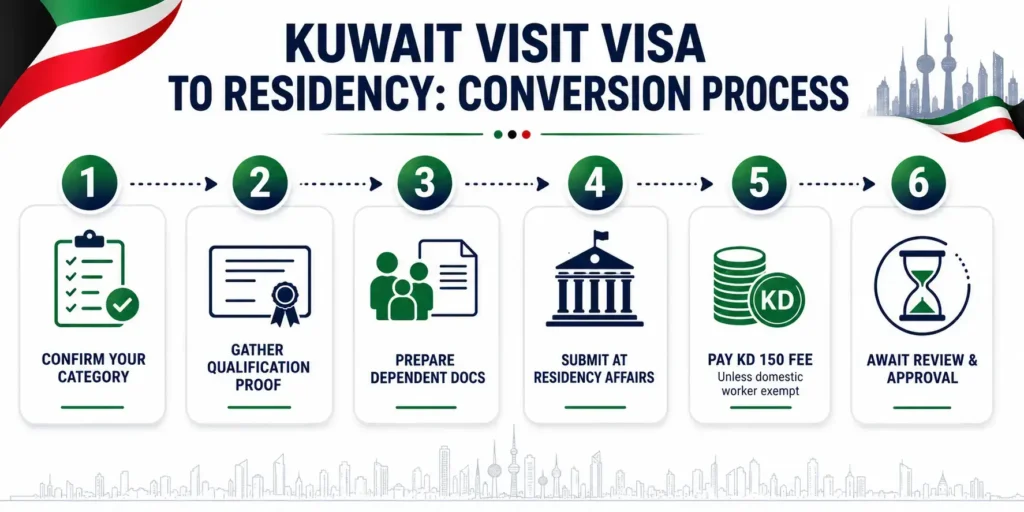
- Confirm which of the five categories applies to you. Before visiting any Residency Affairs office, match your entry visa type and sponsor to the categories above, since walking in without a qualifying basis is the single biggest reason applications are currently being rejected.
- Gather your qualification proof if applying under the government-sponsored route. This means an attested university degree or a recognised technical certification tied to your field.
- Prepare dependent documentation if applying through family reunification. Marriage or birth certificates and proof of your sponsor’s active residency status will be required.
- Submit your application at your governorate’s Residency Affairs department. All six governorates process these conversions, but each case is reviewed individually rather than approved automatically.
- Pay the KD150 fee once your eligibility is confirmed, unless you fall under the domestic worker exemption.
- Wait for review and possible escalation. Straightforward cases are cleared by the Director General of Residency Affairs; more complex ones may require additional sign-off from senior Ministry officials, which can extend processing time.
If your situation involves employment sponsorship specifically rather than a family or government entry route, it’s worth understanding how Kuwait’s private-sector work permit system works before you apply. Our complete guide to Kuwait’s Article 18 work visa for the private sector covers the standard employment residency route this conversion pathway sometimes feeds into. Not sure Article 18 is the right fit? Compare it against Kuwait’s other work visa categories first.
Why So Many Conversion Applications Are Being Rejected
The pattern emerging since the announcement is consistent: applicants are treating the KD150 fee as a general-purpose upgrade rather than a narrow legal mechanism. The most common rejection reasons reported so far are:
- Applying without a genuine government sponsorship or qualifying degree/certification
- Family applicants whose sponsor’s own residency isn’t currently valid or active
- Work-visa applicants who left Kuwait during an emergency but returned after the one-month window
- Standard tourists attempting to use the pathway despite having no qualifying entry category at all
Frequently Asked Questions
Can any Kuwait visit visa be converted to residency now?
No. Only five defined categories qualify: government-sponsored entrants with degrees or technical qualifications, dependents of legal residents, work-visa holders who returned within a month after an emergency departure, and domestic workers. A standard tourist visit visa on its own doesn’t qualify.
What is the Kuwait visit visa fee for a standard entry?
The general visit visa fee for entering Kuwait is KD10. The new KD150 charge is a separate service fee that only applies when converting an eligible visit visa into a regular residency permit, it is not an entry fee.
Do I need to leave Kuwait to convert my visit visa to residency?
No. The entire point of the new pathway under Ministry of Interior Decision No. 1091 of 2026 is that eligible applicants can convert their status without leaving the country, provided they meet the specified conditions and receive approval from Residency Affairs.
Is the KD150 fee refundable if my application is rejected?
Reporting on the rule doesn’t indicate a refund provision, and given that eligibility is checked before the fee becomes payable, the safest approach is confirming you fall into a qualifying category before submitting payment, not after.
Are domestic workers required to pay the KD150 fee?
No. Domestic workers and individuals in similar categories are explicitly exempt from the conversion fee under Article 20 of the executive regulations, though they still need to go through the standard application and approval process.
How long can I stay in Kuwait on a standard visit visa before I need to convert or exit?
A standard Kuwait visit visa typically permits a stay of up to three months. If you don’t qualify for conversion under the new categories and your visa is nearing expiry, extension or exit remains the standard route rather than residency conversion.
Note: This guide reflects Ministry of Interior Decision No. 1091 of 2026 and related official gazette amendments as reported by Kuwait Times and Gulf News in August 2026. Since the Ministry has confirmed that every conversion application is reviewed individually, always verify your specific eligibility with your local Residency Affairs department before submitting an application or paying the KD150 fee. For broader Kuwait visa categories and general entry requirements, see our complete Kuwait visa guide for 2026.