
Bahrain Visa on Arrival 2026: Requirements, Fees and Eligibility
If you are planning a trip to Bahrain, the Bahrain visa on arrival can save you an eVisa application, but it is not open to every passport. This Bahrain visa on arrival 2026 guide explains who qualifies, including Indian citizens, GCC residents and Saudi Iqama holders, what the visa costs, which documents to carry and when it is safer to apply online first.
Can You Get a Visa on Arrival in Bahrain?
Yes, but only some travellers can. Bahrain issues visas on arrival at Bahrain International Airport, and eligibility depends on your nationality or, for some passports, your GCC residency or another qualifying visa.
GCC citizens need no visa. Everyone else must hold a visa, either one issued on arrival where eligible or an eVisa applied for in advance (Bahrain International Airport). Entry is never guaranteed.
| Traveller | Visa on arrival? | What decides it |
|---|---|---|
| Citizens of Saudi Arabia, UAE, Kuwait, Qatar, Oman | Not needed | Enter with a passport or national ID |
| Nationalities on Bahrain’s on-arrival list | Yes, if the conditions for your passport are met | Your nationality plus the conditions shown in the eligibility checker |
| Indian citizens | Only with a qualifying visa or residence permit | Documents you hold, not nationality alone |
| Foreign residents of GCC countries, including Saudi Iqama holders | Yes, if conditions are met | Residence permit validity and occupation |
| Everyone else | No | Apply for an eVisa first |
Which Nationalities Are Eligible for the Bahrain Visa on Arrival?
The authoritative list is Bahrain’s official on-arrival country page. At the time of writing it names 204 nationalities, each marked “Conditions apply”. Clicking a country name opens the official eligibility checker, which is the quickest way to see what applies to your passport. Being on the list is therefore not a guarantee of a visa on arrival.
Bahrain’s pages quote different headline figures. Its national portal refers to visitors from 69 countries, while the on-arrival page is longer. Rely on the checker result for your own passport rather than a headline number.
Passports on the official on-arrival page include the United States, United Kingdom, Canada, Australia, New Zealand, Japan, South Korea, Singapore, Malaysia, China, India, Pakistan and most European countries. Bahrain updates the list from time to time, so check your own passport instead of relying on a copied list.
Passports not on the on-arrival page: several nationalities that can apply for an eVisa do not appear on the on-arrival page at all. They include Bangladesh, Belarus, Iraq, Lebanon, Nigeria, Syria and Yemen. Holders of these passports should apply for an eVisa before travelling.
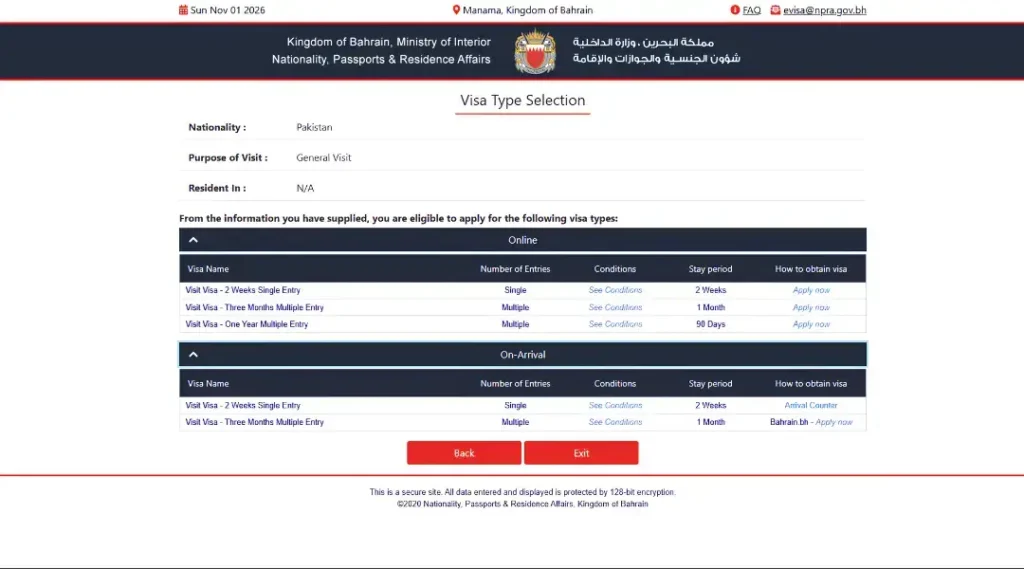
Pakistani passport holders: Pakistan is on the on-arrival list, with conditions attached. In the official eligibility checker, a Pakistani passport with no GCC residence and “General Visit” as the purpose lists both Online and On-Arrival visas. The on-arrival options shown are a two-week single-entry visa, obtained at the arrival counter, and a three-month multiple-entry visa with a one-month stay per visit, which the checker routes through Bahrain.bh. Each has a “See Conditions” link, so read those before you travel, and apply for an eVisa if you cannot meet them.
If your country is not listed, you need a visa before you travel.
Bahrain Visa on Arrival for Indian Citizens
visa on arrival can depend on the traveller’s passport and supporting documents, so Indian nationality alone should not be treated as confirmation of eligibility.
Some travellers may need to meet additional conditions related to valid visas or residence permits issued by other countries. These conditions must be checked against the current official Bahrain visa rules for the individual traveller.
Before departure, Indian citizens should:
- Check their eligibility through Bahrain’s official visa services.
- Confirm whether their supporting visa or residence documents meet the applicable conditions.
- Keep a passport valid for the required period.
- Carry a confirmed return or onward ticket and any other documents requested by immigration authorities.
If the official service does not confirm visa-on-arrival eligibility, apply for the appropriate Bahrain eVisa before travelling.
Bahrain Visa on Arrival for GCC Residents and Saudi Iqama Holders
The Bahrain visa on arrival for Saudi Iqama holders follows the same rules as for other GCC residents, because this route depends on residency, not nationality. A Saudi Iqama is a GCC residence permit, so Iqama holders are treated like residents of the UAE, Kuwait, Qatar and Oman.
Commonly quoted conditions are:
- A residence permit held for more than 3 months
- Enough validity left on the permit. Guidance has been quoted as both 3 and 6 months, so travelling with at least 6 months remaining is the safe choice.
- A skilled occupation. Occupations classed as “labourer” are usually treated as ineligible.
- A passport valid for at least 6 months
- A return ticket and proof of accommodation
GCC resident eVisa is a separate visa category and should not be confused with a visa on arrival. Eligible GCC residents can apply for this eVisa before travelling. NPRA lists a two-week single-entry option with a total fee of BD 10 and a three-month multiple-entry option with a total fee of BD 17. These fees apply to GCC resident eVisas, not to general visa-on-arrival applications.
Documents Required for a Bahrain Visa on Arrival
These Bahrain visa requirements apply to the on-arrival route only. For other visa types, see our Bahrain visa guide. For general entry conditions, eligibility rules and documents required for different travellers, read our Bahrain visa requirements guide.
- A passport valid for at least six months from your arrival date
- Proof you qualify: a listed nationality, or the GCC residence permit or visa described above
- A confirmed return or onward ticket
- Details of where you will stay, and evidence of funds if the officer asks
Border officers decide what to ask for on the day, so keep documents printed or easy to open on your phone.
Bahrain Visa on Arrival Fees and Permitted Stay
| GCC Resident eVisa | Application Fee | Issuance Fee | Total |
|---|---|---|---|
| Two-week single-entry | BD 5 | BD 5 | BD 10 |
| Three-month multiple-entry | BD 5 | BD 12 | BD 17 |
These are GCC resident eVisa fees, not general visa-on-arrival fees. The applicable visa-on-arrival fee and permitted stay should be confirmed through Bahrain’s official visa services.
In the official eligibility checker, the two-week visa is obtained at the arrival counter, while the three-month multiple-entry visa is applied for through Bahrain.bh. These are the amounts most commonly quoted for 2026. NPRA sets the fees and can change them, so confirm the amount at the counter or on the official portal before you pay.
For comparison, a two-week eVisa costs more because it includes an application fee. See our Bahrain eVisa guide for the fee breakdown.
How to Get a Visa on Arrival at Bahrain Airport
These steps are for travellers entering Bahrain on the two-week visa issued at the arrival counter. If you are only changing planes and staying airside, see our guide to Bahrain airport transit rules, because the rules differ from entering the country.
- Before flying, run the eligibility checker at evisa.gov.bh. It asks whether you hold a valid residence permit or visit visa for a GCC country (and which one), your purpose of visit and your passport nationality, then shows which visas you can get. Keep a screenshot of the result.
- After landing, follow the signs to the visa counter before passport control.
- Hand over your passport, qualifying document and return ticket, and pay the fee. Carry both cash and a card.
- Proceed to immigration, where the officer decides whether to admit you.
Who Should Apply Before Travelling?
Do not rely on the airport counter if any of these apply:
- Your nationality is not on the on-arrival list (for example Bangladesh, Nigeria, Iraq, Lebanon, Syria, Yemen or Belarus), or the checker does not offer you a visa on arrival
- You hold an Indian passport but no qualifying visa or residence permit
- Your GCC residence permit has limited validity left (under 6 months, to be safe) or your listed occupation is labourer
- You want your visa confirmed before you board, since airlines may check entry documents at check-in
Our Bahrain eVisa guide explains the application. For work, residence or other visa types, see our Bahrain visa guide.
Frequently Asked Questions
Can I get a visa on arrival at the King Fahd Causeway?
Travellers should confirm the current entry requirements and applicable charges for their nationality and travel category through the relevant Saudi and Bahrain authorities before using the King Fahd Causeway. Saudi residents are commonly advised to carry an Iqama valid for at least 3 months, a passport valid for 6 months and a valid exit and re-entry visa. Exit and re-entry rules are set by Saudi authorities, so confirm the current rules with NPRA and the causeway authorities before you drive.
Can I extend a visa on arrival?
A Bahrain visa extension may be possible depending on the visa category and the traveller’s circumstances. Visitors should contact the Nationality, Passports and Residence Affairs (NPRA) before their permitted stay expires to confirm eligibility, required documents and applicable fees. Approval is not automatic.
NOTE: Bahrain can change its eligibility lists and fees without notice, so confirm your passport and documents on the official portal before you fly.




2 Comments