Article 18 Visa Kuwait 2026: Private Sector Work Permit Rules, Fees & Transfer Process

Getting an Article 18 visa Kuwait private sector job offer comes with where most of the confusion starts, since the fees, timelines, and transfer rules have all shifted through two rounds of reform in the past year. If your employer just handed you an offer letter or you’re already working under this permit and planning a job switch, the details below reflect what the Public Authority for Manpower (PAM) and Ministry of Interior currently require.
This guide covers exactly what the kuwait article 18 visa private sector category involves in 2026: eligibility, the full permit fee structure, exit permit rules that came into effect last year, and how the employer transfer process actually works now.
Core Policy Breakdown: What Article 18 Actually Covers
An article 18 visa kuwait requirements checklist starts with one basic fact: this is the residency category for anyone employed by a private company in Kuwait, separate from government roles (Article 17) and domestic staff positions (Article 20). Not sure this is the right category for you? Compare all Kuwait work visa types first. It is the most popular work permit in the nation, and PAM is the only ministry that handles it. Kuwait’s own e.Government portal draws this same line clearly, listing Article 17 specifically as government-sector residence, which by definition leaves Article 18 as the private-sector counterpart covered here.
What you need before applying:
- A signed job offer from a Kuwaiti company holding an active file with PAM
- A police clearance certificate (PCC) from your home country, attested appropriately
- A clean result from the mandatory government medical examination
- Your employer’s commercial registration and compliance standing with PAM in good order
There’s no fixed minimum salary threshold tied to the visa itself, but your stated pay needs to reflect a realistic market rate for the role, and it directly affects whether you’ll later be able to sponsor dependents under a family visa.
Fees and duration under current rules:
The standard article 18 work permit fee sits at KWD 150 per permit, set under Ministerial Resolution No. 4 of 2025 and in effect since June 2025. The permit itself is typically granted for 1 to 2 years and is renewable, and annual Iqama (residence permit) renewal fees now stand at KWD 20 following the increase that took effect in late December 2025, up from the previous rate. Mandatory health insurance matching your residency duration is now a fixed requirement attached to every renewal.
Article 18 Visa Kuwait Costs at a Glance
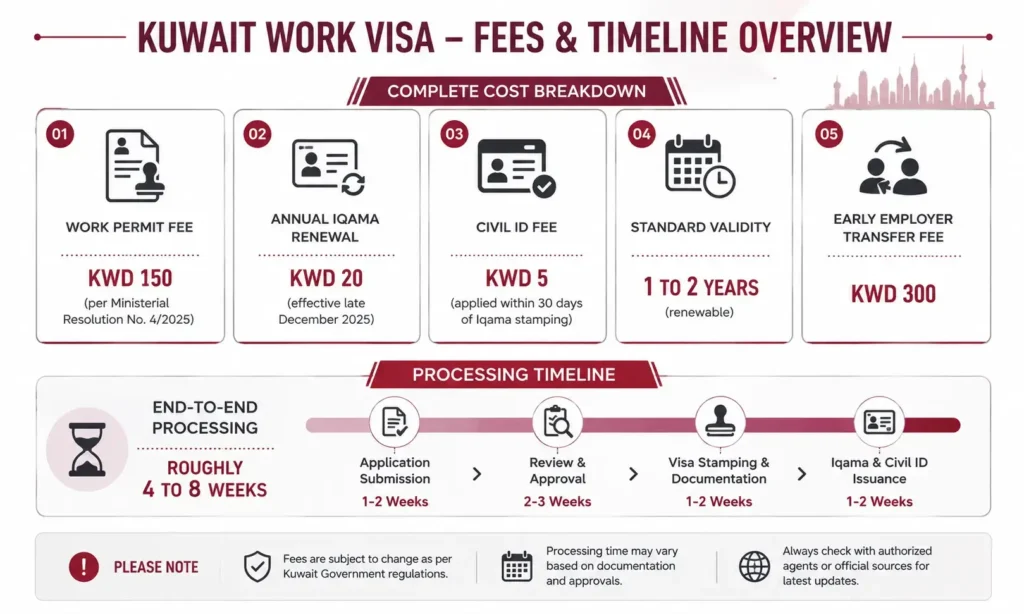
Complete Fee & Timeline Breakdown
Exit Permits: The Rule Most New Workers Miss
Since July 1, 2025, every Article 18 worker needs an electronic exit permit before leaving Kuwait, whether the trip is a short family visit or a permanent departure at the end of employment. This applies regardless of how long the trip is.
The process runs through two connected apps. You submit your request with your Civil ID number and travel dates through the Sahel app, and your employer approves it on their end through the Sahel-Business or Ashal Companies portal, which automatically verifies that the employer-employee match is legitimate before issuing the permit. Each exit permit is valid for 7 days from issuance. As of May 2026, employers can also authorise a multiple-trip permit in advance for staff who travel frequently, which removes the need to approve every single departure individually.
Skipping this step, even for a routine holiday, can hold up your departure at the airport, so it’s worth building the request into your travel planning rather than leaving it for the last minute.
Changing Employers: The Tanazul Transfer Process
Job transfers under Article 18 depend heavily on how long you’ve been with your current employer. If you’ve completed 3 continuous years of service, Kuwait’s labor law generally allows a Tanazul, a residency transfer, without needing a formal release from your existing employer, though PAM approval is still required at every stage. Transfer before hitting that 3-year mark still requires an early transfer fee of KWD 300 on top of the standard KWD 150 permit fee for the new position.
A Kuwait Times report quoting a Kuwaiti residency affairs official confirms this same principle applies even when moving between sectors entirely, an employee can shift from a government role under Article 17 into a private-sector position under Article 18, provided the new role matches or closely resembles their existing profession. What isn’t allowed is starting the new job before the transfer itself is completed through PAM, doing so counts as working without a valid permit and can trigger arrest and deportation proceedings.
Dependent visa holders, meaning spouses or children residing in Kuwait under a family sponsor, can convert their status to a standalone Article 18 permit after 1 year of continuous residence, provided they secure a qualifying job offer.
Step-by-Step: From Job Offer to Residency
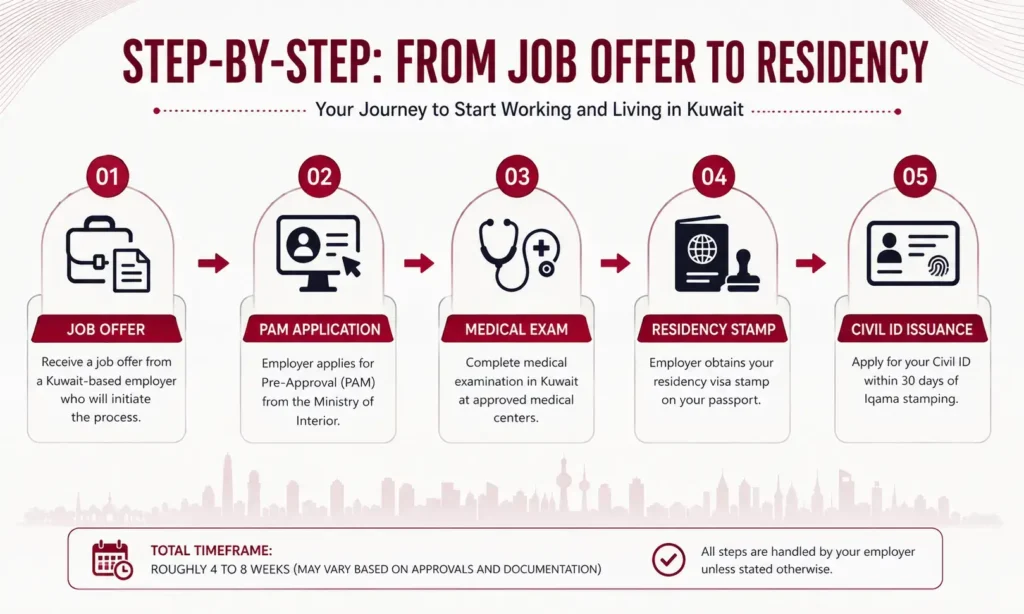
- Confirm your employer holds a valid, active file with PAM, since applications from companies without proper standing get rejected outright. For visit and eVisa status specifically (rather than Article 18 work permits), see our Kuwait visa check guide.
- Your employer submits the work permit application through the Ashal portal, PAM’s official corporate services platform, along with your qualifications and signed contract.
- Obtain your police clearance certificate from your home country and have it attested through the appropriate Kuwaiti diplomatic channel before submission.
- Wait for PAM approval, which typically takes 2 to 3 weeks depending on your profession and how complete the employer’s documentation is.
- Receive your entry visa once the work permit clears, issued through the Ministry of Interior.
- Complete your medical examination at a government-approved health center within days of arrival, covering standard infectious disease screening. Results generally upload to the MOI system within 48 hours.
- Get your residency digitally stamped through the MOI portal or Sahel app once medical clearance and PAM approval are both confirmed.
- Apply for your Civil ID via the PACI portal within 30 days of your residency stamping, paying the KWD 5 fee for a card valid at least 6 months.
Frequently Asked Questions
What is the Article 18 visa in Kuwait?
It’s the residence permit issued to expatriates employed by private sector companies, sponsored entirely through the Public Authority for Manpower. It’s separate from government employment visas (Article 17) and domestic worker permits (Article 20).
How much does an Article 18 work permit cost in 2026?
The permit fee itself is KWD 150, set under a 2025 ministerial resolution. On top of that, annual Iqama renewal runs KWD 20, and a Civil ID card adds a further KWD 5, so budgeting for these separately matters when planning your first year.
Can I change jobs while on an Article 18 visa?
Yes, but the process depends on your tenure. After 3 continuous years with the same employer, a Tanazul transfer generally doesn’t require your current employer’s release, only PAM’s approval. Before that point, transferring still requires an early transfer fee of KWD 300 plus the standard permit fee.
Do I need permission to leave Kuwait on an Article 18 visa?
Yes. Since mid-2025, an electronic exit permit through the Sahel app is mandatory for every departure, temporary or permanent, and your employer must approve it before you travel.
Can my employer hold onto my passport under Article 18?
No. Kuwaiti labor law explicitly prohibits employers from confiscating a worker’s passport, and PAM enforces this through complaints and penalties against non-compliant employers.
Does the Article 18 visa lead to permanent residency?
No. Kuwait does not offer a pathway to permanent residency or citizenship through employment-based visas, regardless of how many years you renew your Article 18 permit.
If you’re still comparing this against Kuwait’s other entry and residency categories, our Kuwait visa guide covers the full four-tier system, visit visas, and eVisa process alongside this one. For the current fee schedule and application status, check directly through PAM’s official portal or the Ashal e-services platform, and Times Kuwait regularly covers PAM policy updates as they roll out.