Dubai Transit Visa 2026: 48-Hour & 96-Hour Requirements

A Dubai transit visa lets a connecting passenger leave the airport and enter the UAE for up to 48 or 96 hours. The UAE Government portal says both types are sponsored by UAE-based airlines and must be processed and approved before you enter the country, so arrange it before you fly. Which option you need depends on the time between your arrival and your departing flight.
Who needs a Dubai transit visa?
The transit visa is for a traveller who wants to enter the UAE during a connection. GDRFA Dubai describes it as a permit that allows a foreign national transiting through the country’s airports to enter as a visitor and stay no longer than 48 or 96 hours.
The UAE Government’s test is based on nationality: if your passport is not eligible for visa on arrival or visa-free entry, you need a transit visa to leave the airport. Emirates lists the passport holders who can disembark at Dubai International and receive a visit visa at immigration without advance arrangements. Some get a free 30-day visit visa and many others a 90-day one, so a transit visa is not part of that route. Check that list for your passport. Indian passport holders with certain US, UK or EU residence documents follow a separate entry route, which our guide to Dubai visa on arrival for Indians explains.
The official sources reviewed do not say whether passengers who stay airside need any visa, and they do not list nationalities that cannot apply. They also give no minimum layover for Dubai. Etihad states a minimum of eight hours for its 48-hour visa at Abu Dhabi, but we found no equivalent rule on the UAE Government or Emirates pages. Confirm these points with your airline instead of relying on figures from unofficial guides.
48-hour vs 96-hour Dubai transit visa
| 48-hour | 96-hour | |
| Time allowed | 48 hours from entry | 96 hours from entry |
| Government fee | Free | AED 50 |
| Emirates price, VAT included | US$10 | US$49 |
| Passport validity | At least 3 months | At least 6 months |
| Entry window after issue | 30 days | 30 days |
| Extension | Not extendable or renewable | Not extendable or renewable |
Choose by the time between your arrival and your departing flight, not by how long you would like to stay. The UAE Government says you must leave within 48 or 96 hours of arrival, and Emirates counts the time from the arrival date. Neither page says whether the clock starts at landing or at the immigration stamp, so leave a margin before your onward flight. That margin is a precaution, not an official rule.
Both the UAE Government and Emirates say the visas cannot be extended, and the UAE Government adds that a 48-hour visa cannot be upgraded to a 96-hour one. A stay longer than 96 hours needs a different entry permit, which this article does not cover. Our UAE visa guide gives the wider picture.
Dubai transit visa requirements and documents
The UAE Government lists three requirements for both visas:
- Passport or travel document: valid for at least 3 months for the 48-hour visa and at least 6 months for the 96-hour visa.
- Photo: a photo of yourself against a white background.
- Onward ticket: a booking to a third destination, other than the one you are coming from.
GDRFA Dubai lists the same kind of documents: a recent colour passport-sized photograph with a white background, a copy of the passport including the cover, and a flight ticket confirming onward travel. As reviewed, its card gives six months of passport validity without separating the two visa types. If you apply through Dubai, a passport with six months left is the safe choice for either visa.
The onward ticket also affects who can sponsor you. Emirates says its transit visas are valid for travel on Emirates tickets outbound from Dubai. Its general visa page lists extra documents for other visa types, such as a hotel reservation, but it gives no separate transit list, so confirm at application whether anything extra is requested.
Many third-party guides mention hotel bookings, proof of funds or travel insurance. The UAE Government, GDRFA and Emirates pages reviewed do not list these as transit visa requirements. Etihad’s visa page, however, says a transit longer than 24 hours needs a confirmed hotel reservation or the host’s UAE residence documents. The version we saw was dated October 2024, so ask the sponsoring airline what it requires today.
How to apply for a Dubai transit visa
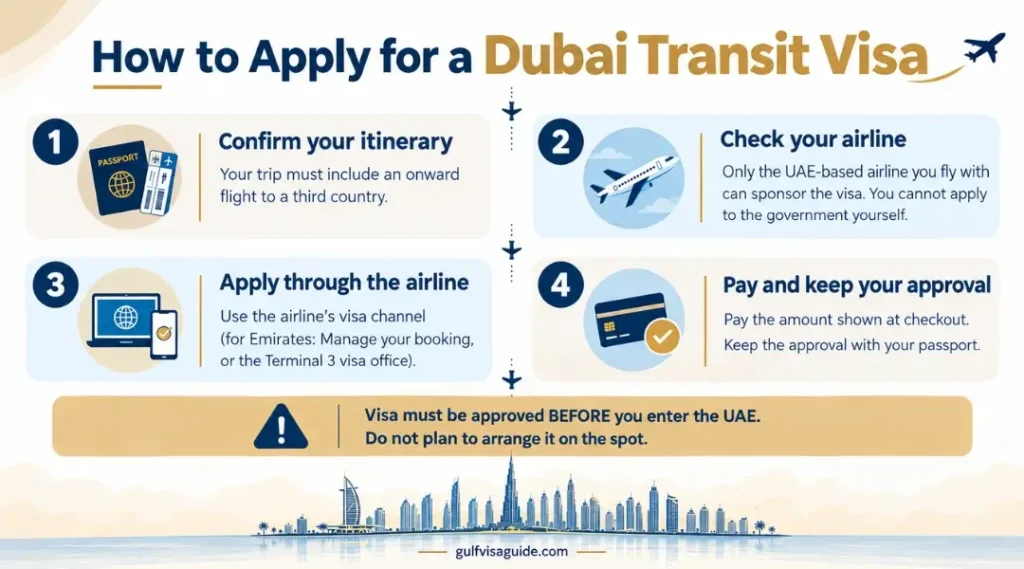
No single airline is mandatory, but you cannot apply to the government yourself. The UAE Government says only the UAE-based airline you are travelling with can arrange the visa. A travel agency can help, but every visa is routed through the airline. Airline agents file the application through the eChannels portal, the UAEICP app or the GDRFA online channels.
GDRFA Dubai says the same in its own words: applications go through approved airlines, and its listed channels include Emirates, flydubai, dnata and airport hotels. The procedures of flydubai and dnata were not reviewed.
For Emirates passengers, the airline says you can apply online through Manage your booking, or at the Emirates Commercial Visa office at Dubai International Terminal 3 Arrivals, which Emirates lists as open daily around the clock. If you fly with another carrier, ask it or your booking agent which sponsor handles the visa.
- Confirm that your itinerary includes an onward flight to a third country and which airline can sponsor you.
- Apply through that airline’s visa channel with the three documents above.
- Pay the amount shown at checkout.
- Keep the approval with your passport. It must be approved before you enter.
The Terminal 3 office is listed as an application point, but the sources do not say whether a passenger already on arrival can use it. Because the UAE Government requires approval before entry, do not plan to arrange the visa on the spot. Some media guides describe applying directly on the GDRFA portal, but the UAE Government and GDRFA pages point to airlines.
Fees and processing time
The UAE Government lists the 48-hour visa as free and the 96-hour visa at AED 50. It adds that no federal, local or private entity may impose additional fees or amounts, and that a departure fee of AED 30 applies to each passenger passing through UAE airports.
Airline prices are higher. Emirates shows US10forthe48-hourvisaandUS49 for the 96-hour visa, VAT included, which is roughly AED 37 and AED 180. Emirates also says additional visa service fees may apply and that transit visa fees are non-refundable in any case. The official sources reviewed do not explain the gap between the government fee and the airline price, so treat the total at your airline’s checkout as the amount you will pay and compare it across sponsors. Some media guides quote AED 120 for the 96-hour visa. We could not confirm that figure on an official page we could read, so treat it as unconfirmed.
GDRFA lists an expected completion time of 48 hours and says the service is available around the clock. Emirates states approximately 2 to 4 working days in its visa terms and asks for at least four international working days for online visa applications in general, without splitting that by visa type. The pages do not explain the difference, so plan around the longer airline figure.
Frequently Asked Questions
Can I extend a Dubai transit visa?
No. The UAE Government and Emirates both say the 48-hour and 96-hour transit visas cannot be extended or renewed, and a 48-hour visa cannot be upgraded to a 96-hour one. If you want to stay longer than 96 hours, you need a different entry permit.
How much passport validity do I need for a transit visa?
The UAE Government lists at least 3 months for the 48-hour visa and at least 6 months for the 96-hour visa. GDRFA Dubai’s card, as reviewed, gives six months without separating the two types, so a passport with six months left is the safe choice if you apply through Dubai.
Can I apply for a Dubai transit visa myself?
Not directly. The UAE Government says only the UAE-based airline you are travelling with can arrange the visa, and a travel agency can help only by routing it through that airline. Start with your airline’s visa page or its Manage your booking section.
Is the 48-hour transit visa really free?
The government fee is nil, according to the UAE Government. Airlines still charge their own price: Emirates shows US$10, VAT included. The official sources reviewed do not explain the gap, so check the total at checkout.
Do I need a transit visa if I stay inside the airport?
The official sources reviewed do not say. The UAE Government describes the transit visa as the permit for passengers who want to leave the airport, so confirm with your airline if you plan to stay airside.
Do I need an onward ticket?
Yes. The UAE Government requires a booking to a third destination, other than the one you are coming from. Emirates adds that its transit visas are valid for travel on Emirates tickets outbound from Dubai.
How long does a Dubai transit visa take to process?
GDRFA lists an expected completion time of 48 hours. Emirates states approximately 2 to 4 working days in its visa terms and asks for at least four international working days for online visa applications in general. Plan around the longer airline figure.
Can I get a refund if I do not use the transit visa?
Emirates says transit visa fees are non-refundable in any case. Other airlines may have different terms, so check before you pay.
What to verify before you travel
The documents and fees above come from the UAE Government portal, GDRFA Dubai, which applies to entry through Dubai, and Emirates for its own passengers. Check these points before departure:
- The sponsoring airline’s current visa page, because the Emirates prices and rules apply to Emirates tickets only
- The total at payment against the amounts in this article
- That your passport meets the validity for your visa type: 3 months for the 48-hour visa and 6 months for the 96-hour visa, or 6 months if you apply through Dubai
- That your onward flight to a third country leaves the UAE before the permitted period ends
- Whether the airline asks for a hotel booking or other documents