Qatar Visa Overstay Fine 2026: Official MOI Rates & How to Pay
If your visa or residence permit in Qatar has already expired, or is about to, the number you need first is this: the Qatar visa overstay fine is QAR 200 for every day you stay past your permitted period on a visit, tourist, or entry visa, capped at QAR 12,000. Residence permit holders work under a separate, lower rate, but a rule change in June 2026 shrank the window they have before that fine starts. This guide breaks down exactly which rate applies to your situation, how the new grace period works, and how to check and settle the fine before it holds up your departure.
Qatar Visa Overstay Fine: The Core Numbers
Qatar’s Ministry of Interior (MOI) applies two different overstay structures depending on what kind of permission you overstayed.
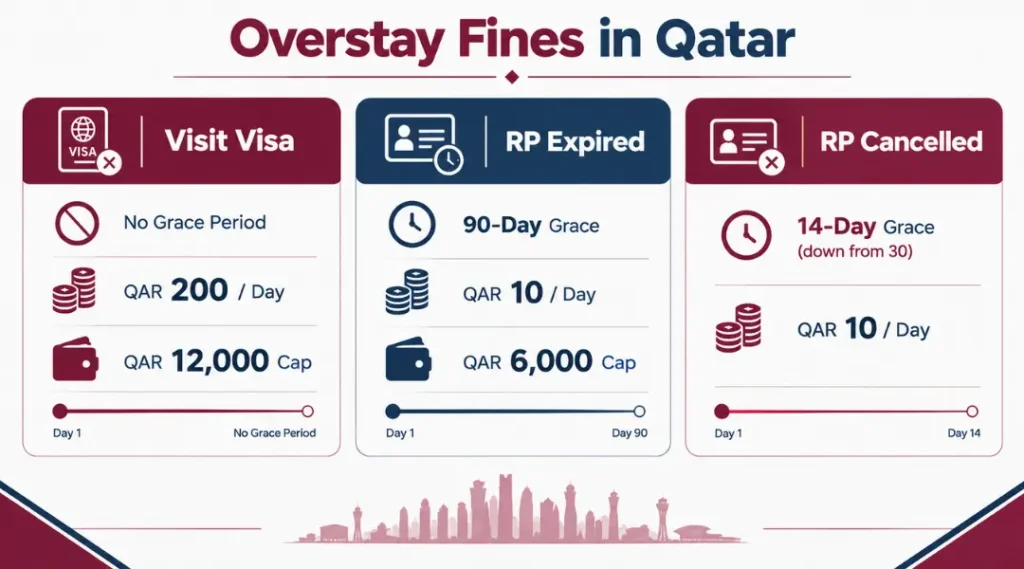
Visit, tourist, and entry visas: There is no grace period. The Qatar visa overstay fine of QAR 200 per day begins accruing from the day immediately after your permitted stay ends, and it keeps adding up until you leave the country or pay in full. The total is capped at QAR 12,000, so even a very long overstay will not exceed that ceiling, but reaching it still means a lengthy, avoidable bill.
Residence permits (QID): This fine is lower, QAR 10 per day, capped at QAR 6,000, but which countdown applies depends on why your permit lapsed.
- If your residence permit simply expired and needs renewing, MOI’s published guidance gives you 90 days from the expiry date to complete the renewal before the QAR 10/day fine begins.
- If your residence permit was cancelled (for example after a resignation, termination, or a sponsor ending your sponsorship), the window is much shorter: 14 days from the cancellation date to leave the country or regularise your status. This was confirmed directly by an MOI Airport Passports Department official, Captain Ali Ahmed Ali al-Kuwari, at a public MOI webinar, where he stated the period had been reduced from 30 days to two weeks. Overstaying past that 14-day window brings the same QAR 10/day fine.
The distinction matters because it is easy to assume the longer 90-day figure applies universally. It does not: a cancelled permit gives you far less time to act than one that has simply run its course.
A quick side-by-side helps before the details, since the two categories are easy to mix up.
| Category | Grace Period | Daily Fine | Maximum Cap |
| Visit / tourist / entry visa | None | QAR 200/day | QAR 12,000 |
| Residence permit (QID), natural expiry, renewal | 90 days | QAR 10/day | QAR 6,000 |
| Residence permit (QID), cancelled by sponsor | 14 days (reduced from 30) | QAR 10/day | QAR 6,000 |
Why the Grace Period Changed
The 14-day rule is recent enough that it is worth explaining plainly rather than assuming everyone has heard. It applies specifically to a residence permit (Iqama) that has been formally cancelled, for example after resigning, being terminated, or a sponsorship ending, not to one that has simply expired on its own (that case still falls under the 90-day renewal window above). It also does not apply to someone on a short Qatar family visit visa or a tourist visa, both of which fall under the stricter QAR 200/day rule with no grace window at all.
In the event that your residence permit is revoked, the 14-day countdown begins on the date that MOI records the cancellation rather than the day you learn of it. Therefore, it is better to check your status early rather than waiting for a notification. Within those 14 days you can do one of three things: leave Qatar, complete a sponsorship transfer to a new employer, or otherwise regularise your status. Anyone sponsored through a Qatar work visa should treat a termination date as the start of this clock, since employers are not always fast about confirming the exact cancellation date.
It is still not confirmed whether the shorter grace period is a permanent policy or a temporary tightening, so this is worth rechecking if you are reading this guide more than a few months after publication.
What Happens If You Don’t Pay
Unpaid overstay fines in Qatar are not a background debt you can ignore and deal with later. They surface at the point that matters most: departure.
- You cannot exit the airport gate or land border until fines are cleared. Immigration counters check outstanding fines as part of standard exit processing.
- A travel ban can be layered on top of an overstay. These are recorded separately from the fine itself, so paying the fine does not automatically clear a ban if one has been issued.
- Unresolved cases can follow you regionally. Because GCC states increasingly share immigration data, an unresolved Qatari overstay or an unclear exit can complicate future visa applications elsewhere in the Gulf.
- Sponsors carry exposure too. On a sponsored visit visa, an unpaid fine becomes the sponsoring resident or company’s problem as much as the visitor’s, since their details are tied to the original application.
If you are trying to avoid this outcome on a visit that is running long, extending before the deadline is almost always cheaper and simpler than paying afterward. The Qatar visit visa extension process, and for those already in the country on family sponsorship, the renewal steps covered in our Qatar family residence visa guide, both walk through how to extend before the clock runs out.
How to Check and Pay Your Overstay Fine
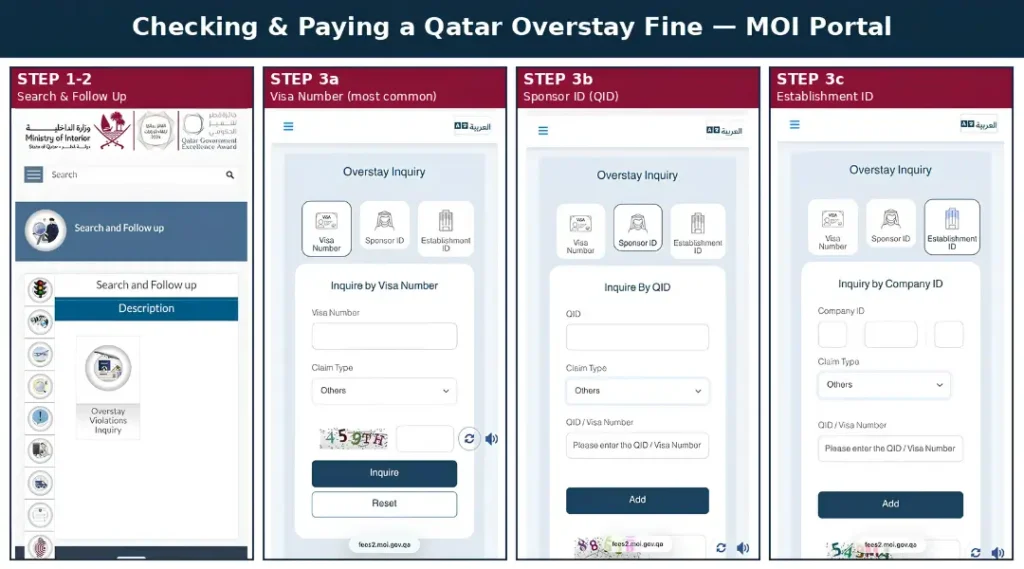
Qatar’s fine system is fully digital. You can check and settle a fine through the MOI E-Services Portal.
- Go to portal.moi.gov.qa and open the “Search and Follow Up” section from the sidebar menu.
- Select the “Overstay Violations Inquiry” card. This opens the Overstay Inquiry form on MOI’s payment gateway.
- Choose how you want to search: the form offers three methods, Visa Number, Sponsor ID, or Establishment ID. Most individuals checking their own case will use a Visa Number.
- For the Visa Number method: enter your visa number, set the Claim Type dropdown to “Others” (the only other option is “Flight tickets,” which is a separate claim type, not the general overstay fine), complete the CAPTCHA shown on screen, and click “Inquire”. (For the Sponsor ID or Establishment ID methods, you enter the QID or Company ID, the same Claim Type choice, and the QID/Visa Number being checked, then click “Add” instead, which appears to let you build up more than one entry before submitting, useful for a sponsor checking several people at once.)
- Review the number of overstayed days and the total fine calculated. The system totals this automatically; you do not need to calculate it yourself.
- Pay by debit or credit card through the secure MOI payment gateway.
- Save or screenshot the payment confirmation for the airport or land border exit check.
Frequently Asked Questions
Do tourist or visitation visas have a grace period?
No. The QAR 200 per day fine on visit, tourist, and entry visas starts the day immediately after the permitted stay ends. Only residence permits carry a grace period, and that window is now 14 days.
What is the maximum Qatar visa overstay fine I can be charged?
For visit and entry visas, the fine is capped at QAR 12,000 regardless of how many days you overstay beyond that point. Residence permit fines at QAR 10 per day are assessed per case rather than capped at a fixed public figure.
Can I pay the overstay fine after I’ve already left Qatar?
The standard process requires settling the fine before departure, since it is checked at the exit gate. If you left without realising you had an outstanding fine, contact an MOI service centre or the Qatari embassy in your country before attempting to return.
Does an unpaid overstay fine automatically blacklist me from Qatar?
Not automatically, but unresolved fines and cases can affect future visa approvals and are sometimes tied to travel bans. Clearing dues promptly is the safest path if you plan to return.
Does the new 14-day rule apply to dependents on a family residence permit?
Yes, dependent residence permits fall under the same immigration framework, so the 14-day grace period and QAR 10/day fine generally apply the same way they do to the primary permit holder.
Where can I find out whether I have an overstay fee right now?
Through the MOI E-Services Portal, the Metrash app, or the Hukoomi portal, using your visa number or QID and passport details.
Note: Qatar’s overstay fines, grace periods, and payment procedures can change based on current MOI rules. Always verify your visa or residence status, applicable fine, and any grace period through the Ministry of Interior (MOI) before making travel or payment arrangements. If you are checking a fine online, confirm the amount shown in the official MOI system or Metrash before proceeding.