
Moving to the UAE, sponsoring a family member, or switching from a visit visa to long-term status all come down to one document: your UAE residence visa. The rules around it changed several times over the past two years, and 2026 brought its own share of updates, from expanded Golden Visa categories to a clearer fee structure across ICP and GDRFA. If you’re trying to figure out which route fits your situation, what it actually costs, and how the paperwork flows, this guide walks through it using only official UAE government sources.
A UAE residence visa is not the same as an entry permit or a work permit, even though the three are often processed back to back. The residence visa is what legally allows a foreign national to live in the country beyond the initial entry stage, and it is issued either by the Federal Authority for Identity, Citizenship, Customs and Port Security (ICP) at the federal level, or by the General Directorate of Residency and Foreigners Affairs (GDRFA) in Dubai. The entire framework sits under Federal Decree-Law No. 29 of 2021 on the Entry and Residence of Foreigners and its Executive Regulations, Cabinet Resolution No. 65 of 2022.
What a UAE Residence Visa Actually Covers
Before comparing visa types, it helps to understand what changes based on how the visa is issued:
- Sponsored visas (employer or family member as sponsor) are typically issued for 1, 2, or 3 years, and the dependent’s visa can never expire later than the sponsor’s own visa.
- Unsponsored, self-sponsored visas Golden Visa, Green Visa, and Blue Visa, run for 5 or 10 years and don’t require an employer or family member to back the application. (All three are detailed in the “Types of UAE Residence Visas” section below.)
- A residence visa is cancelled automatically if the holder stays outside the UAE for a continuous period beyond the permitted limit, this is a separate issue from overstaying inside the country, which our UAE overstay fine 2026 guide covers in detail.
- Every UAE residence visa is directly linked to the Emirates ID, which is issued alongside it and used for virtually every government transaction afterward.
Types of UAE Residence Visas in 2026
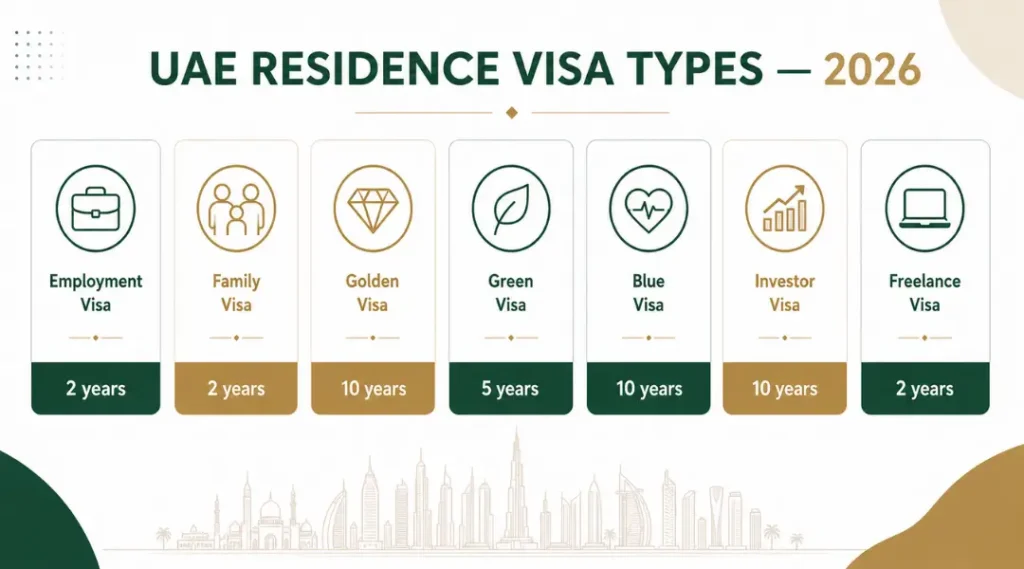
The UAE currently runs seven main residence visa routes. Each has a different sponsor structure, validity, and purpose.
- Employment Residence Visa Sponsored by a UAE-based employer once a work permit is approved through MOHRE. This is the most common category and the one most expats enter the country under. Because the employment side of this process, offer letters, labour cards, MOHRE contracts, is a separate topic on its own, we’ve broken it down fully in our dedicated UAE work visa 2026 guide.
- Family (Dependent) Residence Visa A resident earning a minimum salary of AED 4,000, or AED 3,000 plus employer-provided accommodation, can sponsor a spouse, unmarried daughters of any age, sons under 25, and children with special needs. Anyone being sponsored who is over 18 must pass a medical fitness test at an approved centre. If the sponsor’s own visa is cancelled, every dependent visa linked to it is cancelled as well, though dependents get a grace period to arrange a new status.
- Golden Visa A long-term, renewable residence visa valid for 5 or 10 years, granted without needing a sponsor. Holders can also stay outside the UAE beyond the usual six-month limit without losing their residency, and they can sponsor a spouse and children under the same permit. Eligibility spans investors, entrepreneurs, specialised talents, outstanding students, and humanitarian pioneers, each category carries its own documentation and investment thresholds, which we’ve mapped in full in our dedicated Dubai Golden Visa guide.
- Green Visa A self-sponsored, 5-year residence visa for skilled employees, freelancers, and investors who don’t want to depend on an employer for their legal status. Notably, Green Visa holders can also sponsor first-degree relatives, a right not always available under older sponsorship rules.
- Investor / Property Residence Visa This is the route that gets the least coverage elsewhere, so it’s worth spending more time on, especially since it just changed. Unlike the Golden Visa’s AED 2 million real estate threshold, standard investor/property residence visas exist for smaller investments and shorter terms, and they’re tied to business ownership or property purchase rather than employment:
- Business/company ownership route: A trade licence holder or partner in a UAE-registered company can apply for an investor residence visa directly through ICP, or through the relevant free zone authority if the company is set up there. Requirements vary by legal structure and emirate, but generally include proof of ownership or capital contribution alongside the standard residence documents. Validity typically runs 2–3 years depending on the licence type and emirate.
- Property investor route (Taskeen visa): As of a 29 April 2026 Dubai Land Department (DLD) update via its Cube platform, the long-standing AED 750,000 minimum property value was removed for sole owners, any completed, title-deeded residential unit in Dubai now qualifies, regardless of price, for the standard 2-year investor residence visa. Joint owners still need each co-owner’s share to be worth at least AED 400,000. The property must be completed (off-plan units only qualify after handover) and free of major mortgage restrictions; confirm your exact case with DLD’s Taskeen e-service before applying, since this rule is still relatively new. This is separate from the 5-year retiree visa (AED 1 million property or savings threshold, available only to applicants aged 55+), which follows its own conditions and is not part of the standard investor route.
- Either route generally allows the investor to sponsor a spouse and children, similar to an employment visa, once the residence visa is issued.
- Freelance / Remote Work Visa Designed for individuals working under a freelance permit issued by a free zone, or for people employed by a company outside the UAE who want to live locally while working remotely. The remote/virtual work version runs for one year, needs no local sponsor, but does require proof of income from the overseas employer.
- Blue Visa A self-sponsored, 10-year residence visa reserved for individuals who have made an exceptional contribution to environmental protection and sustainability, whether inside or outside the UAE. It’s aimed at recognised environmental advocates, members of international environmental organisations or NGOs, global award winners, and distinguished researchers or activists in the field and is administered through the ICP Smart Services portal, either via self-application or nomination by a competent authority.
UAE Residence Visa Comparison Table (2026)
NOTE: Government processing fees vary by emirate, application channel, and typing-centre charges, and are not fixed across all cases. Always confirm the exact current fee on the ICP or GDRFA portal before paying, since these are updated periodically.
Documents You’ll Generally Need
While each category has its own checklist, most UAE residence visa applications share this baseline:
- Valid passport with at least 6 months’ remaining validity
- Passport-size photo meeting the official specifications (our UAE visa photo size guide covers the exact background, dimensions, and format ICP accepts)
- Entry permit (if applying from outside the UAE)
- Medical fitness certificate from an ICP-approved health centre (for applicants and dependents over 18)
- Valid UAE health insurance policy
- Category-specific proof, labour contract, marriage/birth certificates, title deed, investment proof, or academic transcripts depending on the visa type
How to Apply: Step-by-Step
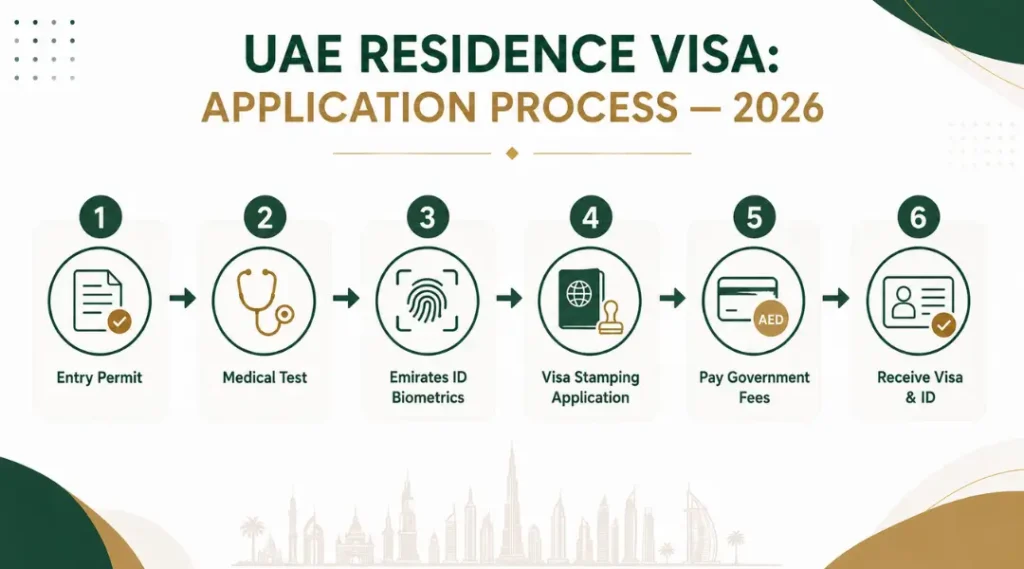
Secure an entry permit if you’re outside the UAE. This is arranged by your sponsor and is usually valid for 60 days to enter the country.
Complete your medical fitness test at an approved typing/health centre, mandatory for anyone 18 or older.
Apply for your Emirates ID by giving biometrics (fingerprints and photo) at an ICP-approved centre.
Submit the residence visa stamping application through ICP Smart Services (federal) or the GDRFA portal (Dubai), attaching your medical clearance and Emirates ID receipt.
Pay the applicable government fees, which are calculated based on visa duration and category.
Receive your stamped residence visa and, shortly after, your physical Emirates ID card.
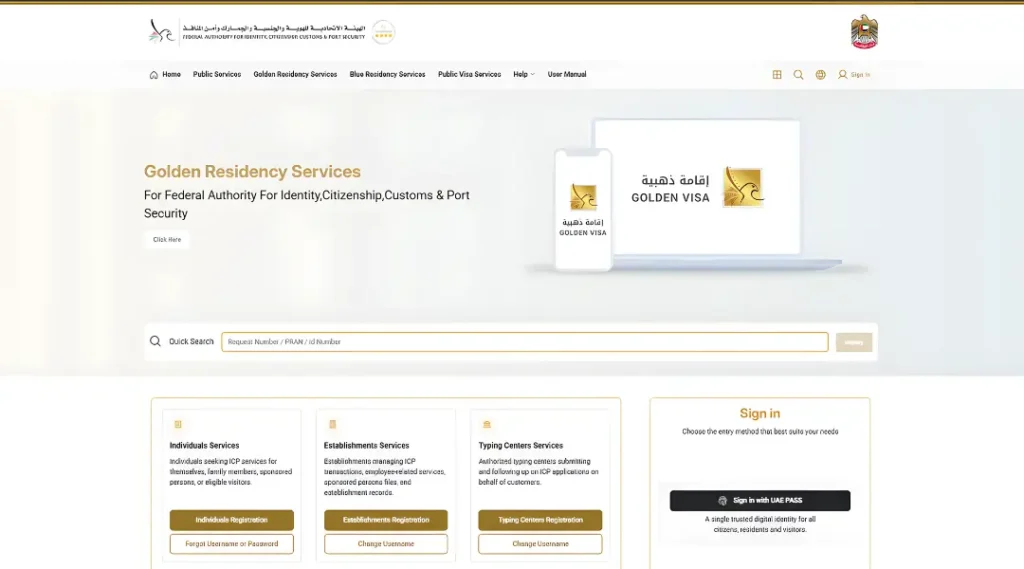
For self-sponsored routes like the Golden Visa, step one usually starts with the “Check your eligibility” tool on the ICP portal before any documents are submitted.
Renewal, Grace Period & Cancellation
A standard sponsored residence visa must be renewed before it expires; the UAE grants a grace period after expiry to renew or change status without immediately triggering overstay penalties, though fines apply once that window closes, this is covered in full in our UAE overstay fine 2026 breakdown. Dependents whose sponsor’s visa is cancelled are separately given a grace period to arrange their own status. Golden Visa and Green Visa holders follow the same renewal principle but on a 5- or 10-year cycle rather than annually or every two years.
Frequently Asked Questions
Is a UAE residence visa the same as a work permit?
No. The work permit is issued by MOHRE and authorises you to be employed; the residence visa is issued by ICP or GDRFA and authorises you to legally live in the UAE. Most employment cases require both, processed one after the other.
Can I sponsor my parents on a UAE residence visa?
Yes, under specific conditions and typically on a yearly basis regardless of your own visa’s duration, subject to income and accommodation requirements set by ICP.
Does the Golden Visa require a UAE employer?
No. The Golden Visa is self-sponsored, meaning you don’t need an employer or family member backing your residency. If you also want to work for a UAE company, that employer still needs to register you with MOHRE separately.
What happens if my residence visa expires while I’m outside the UAE?
Rules vary by how long you’ve been away and your visa category, so it’s best to check directly with ICP or GDRFA rather than assume the same grace period applies as for in-country expiry.
Can Green Visa holders sponsor their family?
Yes, Green Visa holders can sponsor first-degree relatives, which is one of the differences that sets it apart from a standard employment visa.
NOTE: This guide reflects UAE residence visa rules as published on the official ICP and u.ae government platforms as of 2026, including the Dubai Land Department’s 29 April 2026 update removing the minimum property value for sole-owner investor visas. Requirements, fees, and processing times are periodically updated, always confirm current details directly with ICP or GDRFA before applying. For a broader overview of all UAE visa categories, see our UAE Visa Guide 2026.