Bahrain Visa on Arrival 2026: Eligible Countries, Fees and Requirements
If you are planning a trip to Bahrain, the Bahrain visa on arrival can save you an eVisa application, but it is not open to every passport. This guide explains who qualifies in 2026, including Indian citizens, GCC residents and Saudi Iqama holders, what the visa costs, which documents to carry and when it is safer to apply online first.
Can You Get a Visa on Arrival in Bahrain?
Yes, but only some travellers can. Bahrain issues visas on arrival at Bahrain International Airport, and eligibility depends on your nationality or, for some passports, your GCC residency or another qualifying visa.
GCC citizens need no visa. Everyone else must hold a visa, either one issued on arrival where eligible or an eVisa applied for in advance (Bahrain International Airport). Entry is never guaranteed.
| Traveller | Visa on arrival? | What decides it |
| Citizens of Saudi Arabia, UAE, Kuwait, Qatar, Oman | Not needed | Enter with a passport or national ID |
| Nationalities on Bahrain’s on-arrival list | Yes, if the conditions for your passport are met | Your nationality plus the conditions shown in the eligibility checker |
| Indian citizens | Only with a qualifying visa or residence permit | Documents you hold, not nationality alone |
| Foreign residents of GCC countries, including Saudi Iqama holders | Yes, if conditions are met | Residence permit validity and occupation |
| Everyone else | No | Apply for an eVisa first |
Which Nationalities Are Eligible?
The authoritative list is Bahrain’s official on-arrival country page. At the time of writing it names 204 nationalities, each marked “Conditions apply”. Clicking a country name opens the official eligibility checker, which is the quickest way to see what applies to your passport. Being on the list is therefore not a guarantee of a visa on arrival.
Bahrain’s pages quote different headline figures. Its national portal refers to visitors from 69 countries, while the on-arrival page is longer. Rely on the checker result for your own passport rather than a headline number.
Passports on the official on-arrival page include the United States, United Kingdom, Canada, Australia, New Zealand, Japan, South Korea, Singapore, Malaysia, China, India, Pakistan and most European countries. Bahrain updates the list from time to time, so check your own passport instead of relying on a copied list.
Passports not on the on-arrival page: several nationalities that can apply for an eVisa do not appear on the on-arrival page at all. They include Bangladesh, Belarus, Iraq, Lebanon, Nigeria, Syria and Yemen. Holders of these passports should apply for an eVisa before travelling.
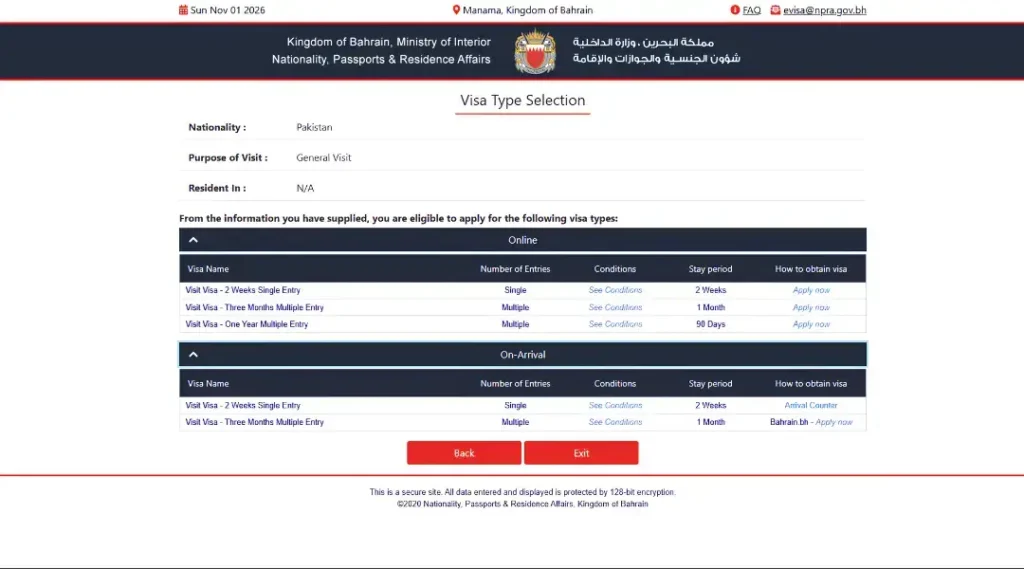
Pakistani passport holders: Pakistan is on the on-arrival list, with conditions attached. In the official eligibility checker, a Pakistani passport with no GCC residence and “General Visit” as the purpose lists both Online and On-Arrival visas. The on-arrival options shown are a two-week single-entry visa, obtained at the arrival counter, and a three-month multiple-entry visa with a one-month stay per visit, which the checker routes through Bahrain.bh. Each has a “See Conditions” link, so read those before you travel, and apply for an eVisa if you cannot meet them.
If your country is not listed, you need a visa before you travel.
Bahrain Visa on Arrival for Indian Citizens
Indian citizens are listed with conditions. An Indian passport alone is not enough.
Indian travellers are generally reported to qualify only if they hold one of the following:
- A valid visa for the United States, United Kingdom or a Schengen country
- A US green card
- A valid visit visa or residence permit for the UAE or Saudi Arabia (Hajj and Umrah visas are excluded)
You also need a confirmed return air ticket. Some guides extend the GCC condition to Kuwait, Oman and Qatar, so run your exact document through the official eligibility checker before you travel.
Indian citizens without any of these should apply for an eVisa before travelling.
Bahrain Visa on Arrival for GCC Residents and Saudi Iqama Holders
This route depends on residency, not nationality. A Saudi Iqama is a GCC residence permit, so Iqama holders follow the same rules as residents of the UAE, Kuwait, Qatar and Oman.
Commonly quoted conditions are:
- A residence permit held for more than 3 months
- Enough validity left on the permit. Guidance has been quoted as both 3 and 6 months, so travelling with at least 6 months remaining is the safe choice.
- A skilled occupation. Occupations classed as “labourer” are usually treated as ineligible.
- A passport valid for at least 6 months
- A return ticket and proof of accommodation
Carry your original residence permit and passport. If your occupation or permit validity does not meet these conditions, apply for a GCC resident eVisa in advance. NPRA offers a two-week single-entry eVisa for GCC residents, applied for from outside Bahrain.
Requirements and Documents
- A passport valid for at least six months from your arrival date
- Proof you qualify: a listed nationality, or the GCC residence permit or visa described above
- A confirmed return or onward ticket
- Details of where you will stay, and evidence of funds if the officer asks
Border officers decide what to ask for on the day, so keep documents printed or easy to open on your phone.
Bahrain Visa on Arrival Fees and Permitted Stay
| Visa on arrival type | Fee | Stay |
| Two-week, single entry | BD 5 | 14 days |
| Three-month, multiple entry | BD 12 | Up to 1 month per visit |
In the official eligibility checker, the two-week visa is obtained at the arrival counter, while the three-month multiple-entry visa is applied for through Bahrain.bh. These are the amounts most commonly quoted for 2026. NPRA sets the fees and can change them, so confirm the amount at the counter or on the official portal before you pay.
For comparison, a two-week eVisa costs more because it includes an application fee. See our Bahrain eVisa guide for the fee breakdown.
How to Get a Visa on Arrival at Bahrain Airport
These steps are for travellers entering Bahrain on the two-week visa issued at the arrival counter. If you are only changing planes and staying airside, see our guide to Bahrain airport transit rules, because the rules differ from entering the country.
- Before flying, run the eligibility checker at evisa.gov.bh. It asks whether you hold a valid residence permit or visit visa for a GCC country (and which one), your purpose of visit and your passport nationality, then shows which visas you can get. Keep a screenshot of the result.
- After landing, follow the signs to the visa counter before passport control.
- Hand over your passport, qualifying document and return ticket, and pay the fee. Carry both cash and a card.
- Proceed to immigration, where the officer decides whether to admit you.
Who Should Apply Before Travelling?
Do not rely on the airport counter if any of these apply:
- Your nationality is not on the on-arrival list (for example Bangladesh, Nigeria, Iraq, Lebanon, Syria, Yemen or Belarus), or the checker does not offer you a visa on arrival
- You hold an Indian passport but no qualifying visa or residence permit
- Your GCC residence permit has limited validity left (under 6 months, to be safe) or your listed occupation is labourer
- You want your visa confirmed before you board, since airlines may check entry documents at check-in
Our Bahrain eVisa guide explains the application. For work, residence or other visa types, see our Bahrain visa guide.
Frequently Asked Questions
Can I get a visa on arrival at the King Fahd Causeway?
GCC residents arriving by road from Saudi Arabia are widely reported to be able to get a visa at the causeway, but the fee and conditions are quoted differently by different sources, from about SAR 50 to SAR 150. Saudi residents are commonly advised to carry an Iqama valid for at least 3 months, a passport valid for 6 months and a valid exit and re-entry visa. Exit and re-entry rules are set by Saudi authorities, so confirm the current rules with NPRA and the causeway authorities before you drive.
Can I extend a visa on arrival?
Bahrain’s official FAQ says visas can be extended inside Bahrain at NPRA offices in Manama or the Muharraq service centre, for a fee. NPRA decides whether a particular visa can be extended and for how long.
NOTE: Bahrain can change its eligibility lists and fees without notice, so confirm your passport and documents on the official portal before you fly.