Kuwait Visa Guide 2026: New Four-Tier System, Types & Fines
If you’re planning to visit, work, or relocate to Kuwait this year, getting your Kuwait visa sorted correctly is the first real step, and the rules changed significantly in the past year. A new four-tier entry system replaced the old, slower process, overstay fines were revised upward, and most applications now run through a single digital platform instead of embassy paperwork. This guide walks through everything currently in effect, based on the latest updates from Kuwait’s Ministry of Interior and General Department of Residency.
Whether you’re after a short tourist trip, visiting family, or applying for a work visa through a Kuwaiti employer, this article breaks down exactly what applies to you in 2026.
What Is a Kuwait Visa and Who Needs One
A Kuwait visa is official permission to enter, stay, or reside in the country, and the type you need depends on your nationality and purpose of travel. GCC citizens (Saudi Arabia, UAE, Qatar, Bahrain, Oman) don’t need a visa at all, they can enter with just their national ID or passport. Everyone else falls under Kuwait’s visa system, which was overhauled in mid-2025 with the launch of the Kuwait Visa Platform.
Every kuwait entry visa now falls into one of two broad categories:
- Visit permits: short-term entry for tourism, business, family visits, or events, these don’t authorize employment.
- Residence visas: long-term status tied to a sponsor, typically an employer under the kafala system, required for anyone planning to live or work in Kuwait.
Working while on a visit visa is illegal and can lead to fines, detention, and deportation, so confirming which category applies to you before booking travel matters more in Kuwait than in most Gulf countries.
Core Policy Breakdown: The New Four-Tier Visa System
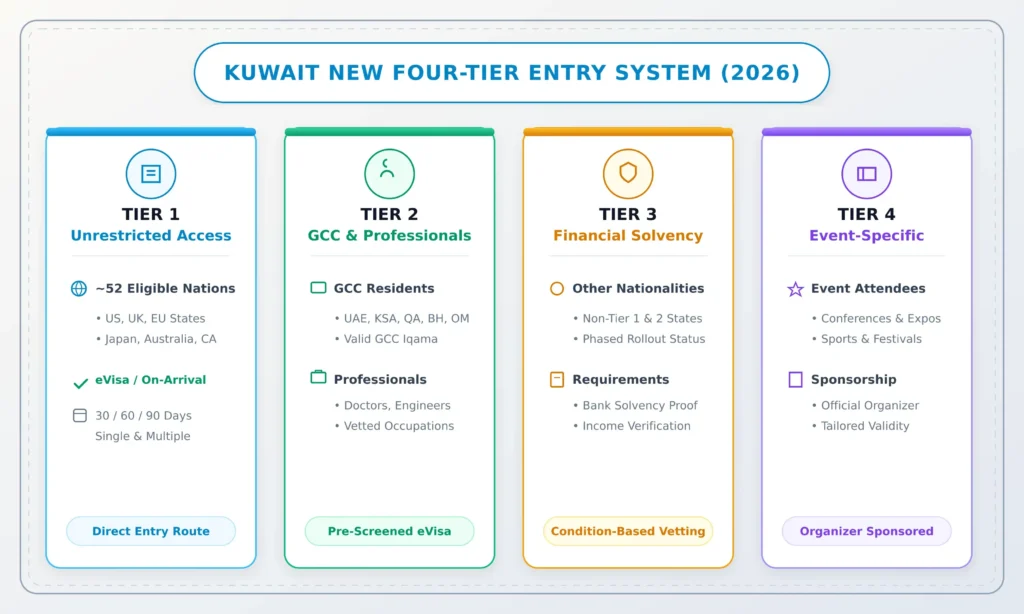
Kuwait’s Ministry of Interior introduced a streamlined Kuwait travel visa structure through the Kuwait Visa Platform, replacing the older embassy-heavy process with a mostly digital one.
Tier One: Unrestricted Access
Passport holders from around 52 countries, including the US, UK, EU/Schengen states, Japan, and Australia, can apply without additional documentation beyond a passport valid for at least six months. This tier covers the full range of visit visa options, from short single-entry stays to longer multiple-entry permits.
Tier Two: GCC Residents and Screened Professionals
Expatriates who legally reside in another GCC country, along with vetted professionals from approved nations, qualify for this tier provided they can show valid residency and basic financial solvency.
Tier Three: Financial Solvency Route
Designed for nationalities outside the first two tiers, this route requires proof of sufficient funds and additional guarantees. It rolled out in phases after the initial launch, so eligibility details are still being finalized for some nationalities.
Tier Four: Event-Specific Visas
Issued for people attending conferences, festivals, exhibitions, or similar organized events, with conditions tailored to the specific occasion.
Under this system, single-entry visas allow stays of 30, 60, or 90 days, while multiple-entry visas run for 3 months, 6 months, or a full year, each entry capped at a 30-day stay. One restriction hasn’t changed: Israeli passport holders remain barred from entry under Kuwait’s 1964 Amiri Decree.
Kuwait Visa Types 2026: Quick Comparison
Visa on Arrival and the eVisa Platform
Nationals from several countries, mostly the same nations covered under Tier One, can still get a visa on arrival at Kuwait International Airport for around KWD 3, without applying in advance. Everyone else applies online before travelling.
The kuwait e visa system runs through the official Kuwait Visa Platform, and applications typically take a few business days to process. To apply, you’ll need a scanned passport copy, a personal photo, and depending on the visa type, a hotel booking or invitation letter from a sponsor. Approved e-visas arrive by email as a digital copy, which you can either print or show on your phone at immigration.
Digital processing doesn’t mean lighter scrutiny. Every traveler is screened on arrival regardless of an approved e-visa, and border officers can still refuse entry if security checks flag a concern.
Article 18 Work Visa: Kuwait’s Private Sector Employment Route
The main kuwait working visa for private sector jobs runs under Article 18 of the residency law. If you’re not sure whether Article 18, 17, or 20 applies to your situation, see our full comparison of Kuwait’s work visa categories. Here’s how the process typically works:
- Secure a job offer from a Kuwaiti company, since self-sponsored work visas don’t exist under the kafala system.
- Your employer applies for a work permit through the Public Authority for Manpower (PAM), matching the role against approved job quotas.
- Receive a No Objection Certificate (NOC) and entry visa once the permit clears.
- Complete a mandatory medical screening at an approved government clinic shortly after arrival, covering standard tests including infectious disease screening.
- Convert your entry visa into a residence permit (Iqama) through the Ministry of Interior’s Residency Affairs Department, which typically also involves biometric registration and a Civil ID application.
The standard Article 18 visa runs 1 to 2 years and is renewable, and employers are legally barred from holding onto your passport. Annual residency fees generally start from KWD 20 and scale up depending on your role and sponsor category. Switching employers requires an NOC and PAM approval, along with a fee of roughly KWD 300 after your first year or so of service; reforms in recent years have made these transfers somewhat faster for skilled roles.
Overstay Fines and Residency Violations
Kuwait significantly increased penalties for residency violations, and there’s no grace period once a visa or permit expires.
- Overstaying a visit visa: KWD 10 per day, capped at a maximum fine of KWD 2,000. This applies uniformly across tourist, family, business, commercial, and transit visit visas.
- Overstaying a residency permit: KWD 2 per day for the first month, rising to KWD 4 per day afterward, up to a maximum of KWD 1,200. In some cases, this can carry a prison term of up to one year alongside the fine.
- Illegal entry into the country: up to three years imprisonment and a fine of KWD 3,000.
- Employers hiring undocumented workers: up to two years imprisonment and fines as high as KWD 100,000.
The daily count starts from your date of arrival for visit visas, not the date the visa was issued, so even a single day past your permitted stay counts as a violation. If you’re on a residence visa nearing expiry, renewing at least 30 days early through the Sahel app is the safest way to avoid triggering these fines.
Step-by-Step: How to Apply for a Kuwait Visa
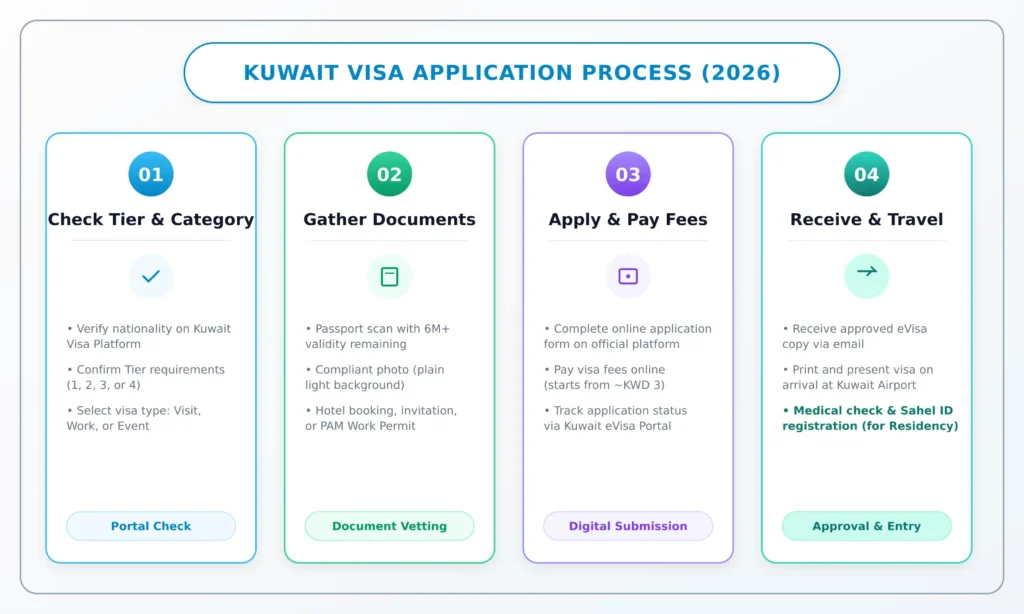
- Check your nationality’s tier on the Kuwait Visa Platform to see whether you qualify for visa-free entry, visa on arrival, or need to apply online in advance.
- Choose the right visa category based on your purpose, tourism, family visit, business, or employment.
- Gather your documents: a passport valid for at least six months, a personal photo against a plain background, and category-specific paperwork such as a hotel booking, invitation letter, or work permit.
- Submit your application through the official Kuwait Visa Platform for most visit visa categories, or have your employer file through PAM for work visas.
- Pay the applicable fee, which varies by visa type and typically ranges from around KWD 3 for a basic visit visa to higher amounts for family or multiple-entry options.
- Wait for approval, usually a few business days for visit visas, longer for work and residency permits pending medical and security checks.
- Complete arrival formalities, including screening at the airport even with a pre-approved e-visa, and register your residence address if required for your visa category.
Frequently Asked Questions
How quickly can one obtain a Kuwait visa?
For eligible Tier One nationalities, a visa on arrival at Kuwait International Airport is the fastest option, no advance application needed. For everyone else, the online eVisa platform is typically quicker than embassy-based applications.
Do GCC citizens need a Kuwait visa?
No. Citizens of Saudi Arabia, the UAE, Qatar, Bahrain, and Oman can enter Kuwait using just their national passport or ID card, no visa or sponsorship required.
Can I work while on a Kuwait visit visa?
No. Visit visas explicitly prohibit employment, and working on one can lead to fines, detention, and deportation. You need a valid Article 18 work visa sponsored by a Kuwaiti employer.
How long can I stay in Kuwait on a tourist visa?
Single-entry tourist visas typically allow stays of 30, 60, or 90 days depending on the option chosen. Most standard visit visas are not extendable, so you need to exit before expiry.
What happens if my Kuwait visa expires while I’m still in the country?
You’ll start accumulating a fine of KWD 10 per day for a visit visa overstay, capped at KWD 2,000, with no grace period. Residency permit overstays carry a separate fine structure starting at KWD 2 per day.
Is Israeli citizenship a barrier to entering Kuwait?
Yes. Under Kuwait’s 1964 Amiri Decree, Israeli passport holders are barred from entry, this is the one nationality restriction that remained unchanged through the 2025 visa reforms.
For the most current specifications tied to your nationality and visa category, apply directly through the Kuwait Visa Platform, check the eVisa service through Kuwait’s e.Government portal, or confirm entry requirements through your nearest Kuwait embassy or consulate.