
Qatar Tourist Visa Cash Requirements: Avoid Costly Mistakes 2026
Qatar Tourist Visa Cash Requirements are one of the most confusing parts of planning a trip to Doha. Some travel forums mention a fixed cash figure, others say a bank card is enough, and a few claim cash isn’t accepted at all anymore. The honest answer depends on your nationality, your visa route, and how immigration officers apply the rule on the day you travel.
This tutorial highlights the one item that most articles completely ignore: the distinction between presenting “proof of funds” for your visa and declaring cash for customs. It also distinguishes between what is constantly reported regarding Qatar’s financial proof requirement and what is still developing.
What Is a Qatar Tourist Visa?
A Qatar tourist visa is the entry permission that allows non-GCC nationals to visit Qatar for leisure, typically for up to 30 days. Depending on your passport, you’ll fall into one of three routes:
- Visa-free entry citizens of over 100 countries can enter without applying in advance.
- Hayya A1 e-visa an online tourist e-visa (QAR 100) processed through the official Hayya platform before you travel.
- Visa on arrival available to select nationalities for a fee paid directly at Hamad International Airport.
Whichever route applies to you, immigration officers can still ask you to demonstrate that you can support yourself financially during your stay. That’s where the confusion about cash usually starts.
Qatar Tourist Visa Cash Requirements: Do You Need to Carry Cash?
Short answer: not strictly, but you do need to be able to prove sufficient funds and for a number of nationalities, this check is applied consistently at the airport, not just on paper.
Qatar’s financial proof requirement isn’t a separate visa document you upload during your Hayya application in most cases. Instead, it’s a condition immigration officers can verify on arrival, alongside your passport, hotel booking, and return ticket. In practice, this means:
- Some travelers are never asked to show anything beyond their passport and travel documents.
- Others particularly from certain South Asian, African, and Middle Eastern countries are asked to present a card, cash, or bank statement at the immigration counter before being allowed through.
Because enforcement varies by nationality and can change, the safest approach is to travel prepared with proof of funds even if you don’t expect to be asked.
Qatar Tourist Visa Financial Proof: What Actually Counts
“Sufficient funds” isn’t a single document it’s any reasonable evidence that you can cover your stay. Immigration officers in Qatar generally accept one or more of the following:
- An international debit or credit card in your name, with available balance
- A recent bank statement (ideally covering the last 3 months, printed rather than digital)
- Physical cash in Qatari Riyal or another major currency
- A combination of the above, especially for families traveling together
A printed statement is worth carrying even if you plan to rely on a card some officers ask for it as backup, and a phone screenshot isn’t always accepted as reliable proof.
How Much Cash Is Required for a Qatar Tourist Visa?
This is the most-searched version of the question, and it deserves a direct answer: commonly cited guidance puts the figure at around QAR 5,000 (roughly USD 1,370), or one funded card per family, for travelers whose nationality is subject to this check. This amount has been widely reported for visa-on-arrival travelers from countries including India, Pakistan, Iran, Egypt, and Bangladesh, among others.
That said, this figure is not published as a fixed legal minimum on Qatar’s official visa pages, and reporting through 2026 suggests the rule is being applied unevenly some accounts describe officers moving away from accepting cash as primary proof altogether, instead requiring a valid international card (plus a printed statement if it’s a debit card). Because this detail changes based on nationality, visa type, and individual immigration officers, treat any specific cash figure as a planning guideline, not a guarantee and confirm current requirements through the official Hayya portal or your airline before you fly.
Qatar Visa Financial Proof at a Glance
The Minimum Cash Counter at Qatar Immigration: What Officers Actually Check
At the arrivals immigration counter, the “financial proof” check is usually quick and informal rather than a separate line or form. An officer reviewing your passport and entry documents may ask you to tap your card, show a bank app or statement, or open your wallet to show cash on hand. There’s no dedicated cash-counting kiosk it’s a spot check built into the standard immigration process, and it’s not applied to every traveler.
A few practical points worth knowing:
- The check tends to be nationality-specific rather than universal.
- Families are often asked to show one sufficient source of funds per group, not per individual.
- Officers generally accept a reasonable buffer above the minimum rather than requiring an exact figure.
- If your documents (hotel booking, return ticket, insurance) are already in order, the funds check is usually brief.
Doha Airport Cash Check: What Happens at Immigration
It helps to picture the actual sequence at Hamad International Airport (HIA):
- You queue at the immigration counter with your passport and any pre-approved Hayya visa.
- The officer verifies your passport validity, hotel booking, and return or onward ticket.
- If your nationality is flagged for the funds check, you’ll be asked to show a card, cash, or statement.
- Once satisfied, the officer stamps your entry and you proceed to baggage claim.
This is a completely different process from customs cash declaration, which is frequently confused with the visa funds check. Qatar requires travelers carrying amounts above QAR 50,000 (in QAR or any other currency) to declare it on arrival this is a customs and anti-money-laundering rule, not a visa requirement, and it only applies to unusually large sums, well beyond what any tourist needs to demonstrate for visa purposes. In other words: showing QAR 5,000 in proof of funds and declaring QAR 50,000+ in cash are two entirely separate checks, at two different thresholds, for two different reasons.
Cash vs Card: Which Is Safer for Qatar Entry?
Both are accepted in most cases, but they carry different trade-offs.
A practical middle ground many travelers use: carry a funded international card as your primary proof, a printed recent bank statement as backup, and a modest amount of cash (QAR or USD) for small purchases and taxis not as your official financial proof, but for everyday convenience.
Documents to Carry Alongside Your Financial Proof
Cash or card proof rarely stands alone immigration checks it alongside your other entry documents. Make sure you also have:
- A passport valid for at least three to six months beyond your arrival date (validity requirements vary by nationality)
- Your Hayya e-visa confirmation, if you applied in advance confirm it’s been approved through our Qatar visa check guide before you travel.”
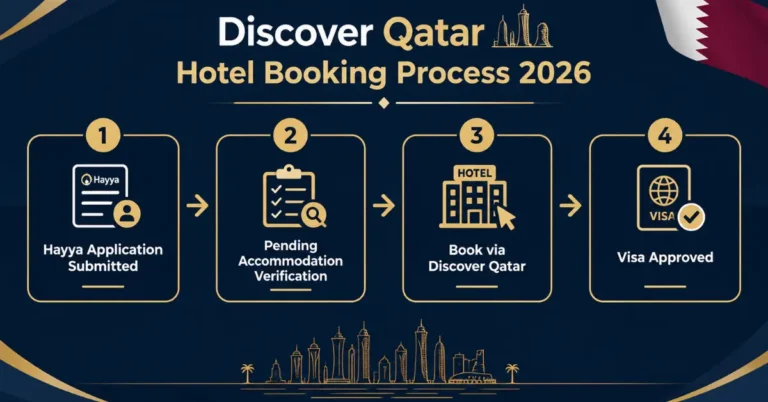
- A confirmed hotel booking or, for some nationalities, a booking made specifically through Discover Qatar
- A confirmed return or onward flight ticket
- Health insurance valid in Qatar mandatory for stays over 30 days, and recommended even for shorter trips through Qatar’s Ministry of Public Health health insurance scheme
If you’re also researching related entry paperwork, our guide on Qatar visa requirements covers documentation for other visa categories, and our health card guide is useful if your trip involves any Qatar-issued health documentation.
What Happens If You Don’t Meet Qatar Tourist Visa Cash Requirements?
Falling short on financial proof doesn’t automatically mean deportation, but it can mean real disruption to your trip:
- Delayed entry while officers verify your documents or consult a supervisor
- Requests for alternative proof, such as a phone call to a sponsor or additional bank documents
- Denied boarding at your departure airport if airline staff pre-screen documents and find them insufficient
- Refused entry on arrival, in rare cases, if no reasonable proof can be shown at all
Airlines flying into Doha are generally strict about pre-departure document checks precisely because they’re liable for flying back passengers who are refused entry. That’s why it’s worth resolving your financial proof before you reach the airport, not after.
Common Mistakes Travelers Make With Qatar Visa Financial Proof
- Assuming the rule doesn’t apply to them. Enforcement is nationality-based and can appear inconsistent, but that doesn’t mean it won’t apply to your specific flight.
- Relying only on a phone screenshot of a bank balance. A printed or downloadable PDF statement is more reliable if an officer asks for documentation.
- Carrying only cash in a currency other than QAR or USD. Less common currencies can complicate a quick verification.
- Confusing the visa funds check with the customs declaration threshold. They’re different rules with different amounts.
- Not checking requirements close to the travel date. Because this specific rule isn’t fixed in official published guidance, it’s one of the more fluid parts of Qatar’s entry process.
Frequently Asked Questions
How much cash is required for a Qatar tourist visa?
There’s no single published legal minimum, but a figure of around QAR 5,000 (~USD 1,370) per family or card is the most commonly cited benchmark, mainly for visa-on-arrival travelers from specific nationalities. Confirm current expectations through Hayya or your airline before you fly.
Do I need cash, or is a card enough for Qatar entry?
A funded international card is generally accepted as proof of funds, and recent reports suggest it’s becoming the preferred form for several nationalities. Carrying a printed bank statement alongside your card is a sensible backup.
Is the Qatar visa financial proof check the same as the airport cash declaration rule?
No. The financial proof check relates to your visa entry conditions. Separately, Qatar requires anyone carrying more than QAR 50,000 in cash (any currency) to declare it at customs a much higher threshold aimed at large cash movements, not everyday tourist funds.
Does every traveler get asked to show proof of funds in Qatar?
No. The check is applied inconsistently and tends to focus on specific nationalities and visa-on-arrival travelers rather than every visitor.
What if I can’t meet the cash requirement for my Qatar tourist visa?
You risk delayed processing or, in some cases, denied entry. It’s safer to arrange a funded card, printed bank statement, or appropriate cash before departure rather than resolving it at the counter.
Final Thoughts
The reality behind Qatar tourist visa cash requirements is less rigid than a lot of headlines suggest, but that flexibility cuts both ways because the rule isn’t fixed in official published policy, it’s applied at the discretion of individual immigration officers and can shift over time.
The safest approach is straightforward: carry a funded international card, a printed recent bank statement, and a reasonable amount of cash, keep your other entry documents in order, and verify current expectations through Hayya or your airline shortly before you travel. Do that, and the financial proof check becomes a formality rather than a risk to your trip.

One Comment