Qatar Business/Investor Visa 2026: Requirements & Fees
If you’re travelling to Qatar for meetings and short-term business activity, you need a business visit visa; if you’re looking to secure long-term residency through property or capital investment, you need Qatar’s investor residency route. The two get bundled together in search because both fall outside a standard employment visa, but the eligibility, cost, and what you actually get at the end are very different, and this guide breaks down both tracks with the current 2026 figures.
Qatar Business Visa: Who It’s For and What It Covers
A Qatar business visa is a short-term entry permit for professionals attending meetings, conferences, trade shows, or contract negotiations. It does not authorize employment, and holding one does not create any residency rights; it functions purely as a visit visa with a business purpose attached. Anyone planning actual paid work inside Qatar needs a work permit instead, which follows an entirely different sponsorship route than our Qatar work visa guide covers in full.
Eligibility and sponsorship: A Qatari sponsor is mandatory for most business visa categories: typically an MOI-accredited local company that issues an invitation letter confirming the purpose of your visit. Without this sponsoring establishment clearing the voucher ahead of your arrival, the visa cannot be issued.
Documents typically requested:
- Valid passport with at least six months’ remaining validity
- Invitation letter from the sponsoring Qatari company
- Recent passport-size photos
- Bank statements showing sufficient funds
- Confirmed hotel booking and return ticket
- Proof of company registration, for the inviting business
Duration and extensions: The standard business visit visa runs for 30 days and can be extended for a further 60 days, taking the total to three months, at a fee of roughly QAR 200 per month for the extension. A separate 90-day business visa category exists for longer assignments such as consulting or short-term contract work, and this can sometimes be extended up to nine months, though approval for the longer extension depends on meeting specific conditions rather than being automatic.
Fees: The standard businessmen visa fee sits around QAR 200, with short-duration entry vouchers (72-hour categories) priced lower at around QAR 100, and multi-entry long-term business vouchers running higher. Mandatory health insurance is typically billed at around QAR 50 per month on top of the visa fee itself. Processing generally takes three to seven working days once the sponsor’s documents clear.
Qatar Investor Visa: Long-Term Residency Through Investment
Qatar does not officially brand this as a “Golden Visa,” but the Investor Residence Visa (also referred to as the Owner of Premises Residence Permit for the property route) functions as the country’s residency-by-investment program. Unlike the business visa above, this is about securing a renewable or permanent right to live in Qatar, not just visit it, and it comes with the ability to sponsor a spouse and dependent children in a way that mirrors how our Qatar family residence visa guide describes standard family sponsorship.
There are two main property-based investment tiers, alongside a separate business-setup route:
Temporary renewable residency requires a minimum real estate purchase of around QAR 730,000 (roughly USD 200,000) in an approved freehold zone such as The Pearl, Lusail City, or parts of West Bay. Sources genuinely disagree on how long this permit runs: some official-adjacent legal sources describe it as a one-year permit renewable annually, while several other established sources describe it as a five-year renewable permit. This isn’t a case of one source being clearly wrong; confirm the current validity period directly with Invest Qatar or a licensed legal representative before finalizing plans around it. What’s consistent across all sources is the roughly 90-day minimum physical presence requirement each year to keep the permit active.
Permanent residency requires a substantially larger real estate investment, around QAR 3.65 million (roughly USD 1 million). This tier does not carry a minimum stay requirement and grants a longer-term, non-renewing residency status, though Qatar caps approvals for this permanent category at roughly 100 a year, so processing can take longer and demand exceeds the yearly allocation in some periods.
Business-setup residency is the alternative path for investors who prefer to establish a company presence rather than buy property. This runs through Qatar’s Ministry of Commerce and Industry alongside Invest Qatar, the government’s official single-window investment promotion agency, and typically results in a two-year renewable residence permit tied to the registered business rather than to a property title. Specific fee figures for this route weren’t fully verifiable at the time of writing, so confirm current costs directly with Invest Qatar before budgeting.
An existing lower-cost entrepreneur route also predates the 2026 announcements below and is worth knowing about if the property thresholds are out of reach. It requires a minimum business investment of QAR 250,000, a minimum 20% equity stake in the venture, and endorsement from one of Qatar’s accredited business incubators, such as the Qatar Business Incubation Center (QBIC), Qatar Science & Technology Park (QSTP), Scale7, Qatar FinTech Hub, or Qatar Museums’ M7. Approved applicants receive a five-year renewable residence permit, with a government processing fee of around QAR 5,000.
Qatar also introduced new Executive and Entrepreneur long-term residence categories in early 2026, aimed at senior global talent and high-potential founders, offering permits of up to ten years. These sit alongside the property and business-investment routes rather than replacing them. The Executive category is built for senior leadership roles: confirmed eligibility includes a minimum monthly salary of QAR 50,000 for positions such as Chairman, CEO, CFO, COO, or CTO, alongside at least five years of senior executive management experience and a direct employment contract with a qualifying Qatari company.
The Entrepreneur category under this newer track requires a minimum bank balance of QAR 36,500 held over the preceding three months, plus an official endorsement letter from an accredited incubator such as QSTP or Qatar FinTech Hub. Eligibility details for both categories continue to be refined, so confirm current qualifying conditions directly with Invest Qatar before assuming you meet the bar.
Documents typically required for the investor route:
- Proof of the property purchase price or business investment, with supporting bank records
- Proof of funds and source-of-funds documentation
- Medical fitness clearance and police clearance certificate
- Valid health insurance
- For permanent residency specifically, some applicants report a basic Arabic-language or integration requirement being assessed
The medical clearance step runs through the same government-authorized screening process our QVC medical report guide walks through for other residency categories.
Indicative 2026 fees for the property investor route (these vary significantly by category, provider, and processing speed; some sources report combined totals running well above the figures below, so treat this as a starting reference rather than a ceiling):
Business Visa vs Investor Visa: Quick Comparison
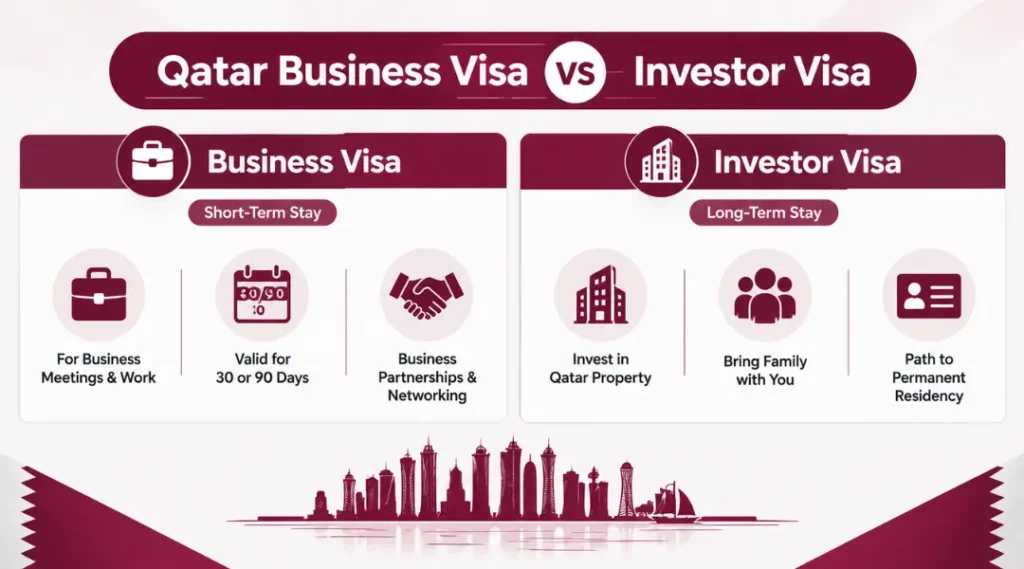
Once you strip away the paperwork, the choice really comes down to what you need out of your time in Qatar. A business visa gets you in the door for a defined stretch of work, meetings, or deal-making, with no long-term commitment attached. An investor visa asks for real capital up front but hands back years of residency, family sponsorship, and a genuine foothold in the country. The table below lays out that trade-off at a glance.
Step-by-Step: Applying for Each Route
For the business visa:
- Secure an invitation letter from an MOI-accredited Qatari sponsoring company.
- The sponsor clears the entry voucher through official MOI or Hayya channels before your travel date.
- Submit your passport, photos, bank statements, and travel documents alongside the voucher.
- Pay the applicable visa and insurance fees.
- Travel to Qatar within the voucher’s validity window, and extend in-country if your stay needs to run past the initial 30 days.
For the investor route:
- Identify a qualifying property in an approved freehold zone, or register a business through Invest Qatar’s single-window process.
- Complete the purchase or investment and gather proof of funds and source-of-funds documentation.
- Undergo the required medical exam and police clearance.
- Submit the residency application through the relevant government channel, along with your investment documentation.
- Once approved, complete standard residency onboarding, including QID issuance, the same way any new resident would under our broader Qatar visa guide.
- Track your application status the same way you would for any other Qatar visa, through a standard Qatar visa status check.
Common Mistakes to Avoid
- Assuming a business visa allows paid work inside Qatar, which it does not under any circumstance
- Purchasing property outside an approved freehold zone and only discovering it doesn’t qualify for residency afterward
- Letting the underlying investment lapse or sell it off, which can void the renewable residency tier
- Treating the permanent residency route as guaranteed approval simply because the investment threshold is met, when Qatar caps annual approvals for that tier
Frequently Asked Questions
Can a Qatar business visa be converted into a work visa?
Not directly. A business visa is a short-term visit permit, and paid employment requires a separate work permit process initiated by an employer, following the sponsorship route in our work visa guide.
How much does the Qatar investor visa cost in total?
Beyond the property or business investment itself, government processing fees are commonly cited in the QAR 6,000 to 12,000 range for the standard property route, though some sources report combined totals running considerably higher depending on due-diligence complexity and the provider handling the application. Confirm exact figures with Invest Qatar or your legal representative before committing funds.
Does the Qatar investor visa let me sponsor my family?
Yes. Both the temporary and permanent investor residency tiers allow the primary investor to sponsor a spouse and dependent children, similar to standard family sponsorship rules.
Is there a minimum stay requirement for investor residency?
The temporary renewable tier (around QAR 730,000 investment) generally requires roughly 90 days of physical presence in Qatar per year to maintain the permit. The higher permanent residency tier does not carry the same minimum stay requirement.
Can I extend a 30-day business visa while inside Qatar?
Yes, in most cases, for a further 60 days at roughly QAR 200 per month, bringing the total stay to about three months, though this depends on your sponsor supporting the extension and your case meeting current conditions.
NOTE: For the latest official criteria on business and investor visa categories, Qatar’s Invest Qatar portal, specifically its Residency Program page, and the Hukoomi government services portal remain the two authoritative sources to check before finalizing an application.